

Search our site for

About the placenta
Key facts
- The placenta is the first organ to form during pregnancy — it delivers oxygen and nutrients to your baby and is essential for growth.
- Complications with the placenta can be very dangerous to both you and your unborn baby.
- In twin pregnancies or other multiple pregnancies, it’s possible to have multiple placentas.
- Medicines and substances, such as alcohol and nicotine, can cross from your bloodstream to the placenta — this can affect your baby's health.
- It’s your choice how you birth your placenta — talk to your healthcare team to make an informed decision about your healthcare during pregnancy and birth.
What is the placenta?
The placenta is a temporary organ that develops during pregnancy. It begins developing when you first become pregnant and is delivered after your baby is born.
The placenta attaches to the lining of your uterus and delivers oxygen and nutrients to your growing baby through the umbilical cord.
If something goes wrong with the placenta, it can be serious and even life-threatening for both you and your baby.
In some cases, your doctor may recommend examining your placenta after birth. This can help them to:
- identify the cause of any pregnancy complications
- provide information for future pregnancies
When does the placenta form?
The placenta starts forming at the time your fertilised egg implants in your uterus. It continues to develop in your uterus throughout your pregnancy.
Once your baby is born, the placenta is no longer needed. It’s pushed out naturally, or with help from your midwife, after the birth of your baby. This is also known as the third stage of labour or the afterbirth.
What is the role of the placenta during pregnancy?
The placenta has many roles during pregnancy, including:
- passing oxygen and nutrients to your baby
- carrying waste products, such as carbon dioxide, from your baby back to your blood so your body can get rid of them
- preventing some harmful substances, such as viruses, from reaching your baby
- making the hormones that are needed for pregnancy, birth and breastfeeding
What is the normal position of the placenta during pregnancy?
The placenta should attach to the wall of the uterus:
- at the top
- on the sides
- on the front
- on the back
The exact location of the placenta will vary from person to person and in each pregnancy.
The placenta can sometimes develop low in the uterus, but it will generally move higher as your uterus stretches. The position of the placenta will be checked via ultrasound, early in your first and second trimester.
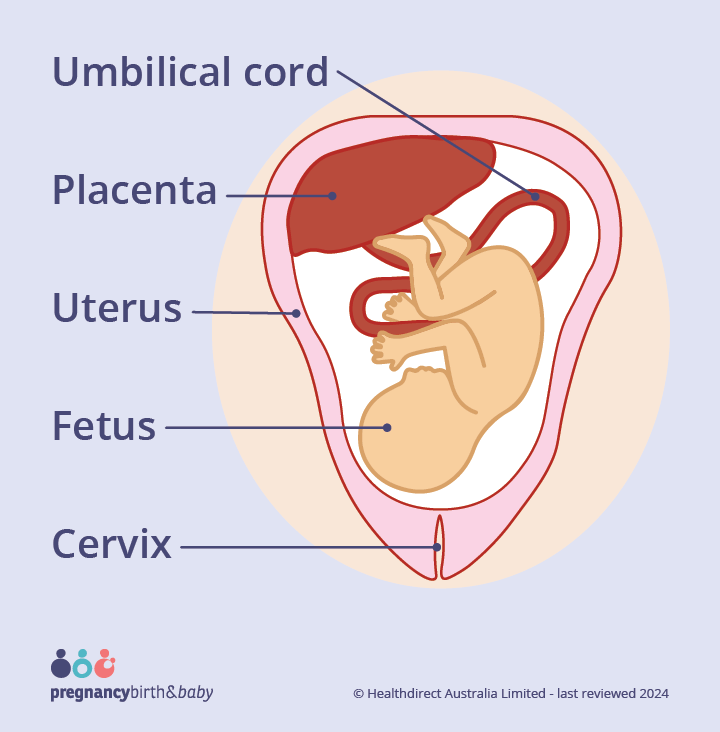
Illustration of normal placental location during pregnancy.
How does the placenta work in twin and other multiple pregnancies?
How the placenta works if you are having twins or other multiple pregnancies depends on whether they come from separate eggs:
- Fraternal twins or other multiple pregnancies come from separate eggs. This means they each have their own placenta during pregnancy.
- Identical twins or multiple pregnancies come from the same egg that splits after fertilisation. This means they may share a placenta during pregnancy or each have their own.
An ultrasound can help determine whether you are having a fraternal or identical multiple pregnancy, and whether your babies share a placenta.
Can medicines and other substances cross the placenta?
Some substances can cross the placenta and affect your baby's health, including:
Because alcohol can affect your placenta, you should not drink alcohol when you're pregnant. Read more on alcohol and pregnancy.
Smoking or vaping during pregnancy can harm both you and your baby. Cigarette smoke and vapour from e-cigarettes, also known as vapes, contain poisonous chemicals, such as nicotine. These chemicals can cause pregnancy complications and may affect your baby's development. The best way to protect yourself and your baby is to avoid or quit smoking and vaping.
Let your doctor and pharmacist know that you are pregnant, so that they only prescribe and dispense medicines that are safe for your baby. Read more on medicines during pregnancy.
If you are worried about your substance use during pregnancy, talk to your doctor. They can support you and help you make a plan to keep you and your baby healthy during your pregnancy.
Can anything go wrong with my placenta?
Most abnormalities with the placenta are out of your control. They include:
- where your placenta attaches in the uterus
- the structure of your placenta
- how your placenta functions
What can go wrong with the placenta?
Problems with your placenta can happen during pregnancy, during birth or after birth. These are potentially dangerous for both you and your baby:
- Placental abruption is when some or all the placenta comes away from the wall of your uterus before your baby is born.
- Placenta praevia is when the placenta partially or totally covers your cervix (the opening of the uterus). This can make it hard for your baby to be born.
- Placental insufficiency is when the placenta doesn't work properly during pregnancy. This means your baby may not get enough oxygen and nutrients needed to grow and develop.
- Placenta accreta is when the placenta attaches too deeply into the wall of your uterus. This can lead to severe bleeding during or after birth and can be life-threatening.
- Retained placenta is when all or part of your placenta does not come out after the birth. This might be because it’s stopped by your cervix or is still attached to your uterus.
Vaginal bleeding during late pregnancy is often due to a problem with your placenta. If you experience bleeding, contact your doctor or midwife as soon as possible for advice.
What can I do to keep my placenta healthy during pregnancy?
Here are some tips to help keep your placenta healthy during pregnancy:
- Visit your healthcare provider regularly during pregnancy.
- Tell your doctor if you have had problems with the placenta in a previous pregnancy. You should also tell your doctor if you have had any surgery to your uterus, such as a caesarean.
- Avoid smoking, drinking alcohol or taking drugs during pregnancy. This can increase the chance of complications with the placenta or your baby.
- Always talk with your doctor or pharmacist before you take any medicine during pregnancy. This includes over-the-counter medicines, natural therapies and supplements.
What happens to the placenta after my baby is born?
After your baby is born, you will need to birth your placenta. This is called the third stage of labour. This stage of labour can be managed in different ways, including:
- active management — this involves medicines called uterotonics to help your uterus contract. Once the placenta has started to separate from the wall of your uterus, your healthcare team will then help gently deliver it.
- physiological management — this is when the placenta is delivered without any medical intervention. This is only recommended in low-risk cases as it can increase your chance of having a postpartum haemorrhage (severe bleeding after birth).
- surgical removal — if part of the placenta doesn't come out, your doctor may recommend having it surgically removed to prevent infection.
If you have a caesarean section, your doctor will recommend removing the placenta at the same time your baby is born.
Your health team will explain your options to you — this is known as 'informed consent'. Informed consent means that you will be given enough information to make decisions about your health and healthcare. It’s your choice how you birth your placenta.
Once you birth your placenta, your doctor or midwife will check that it looks complete. If they are concerned that your placenta isn't complete, they may suggest further investigations.
Lotus birth
A lotus birth is when you keep the umbilical cord connected to the baby after birth, rather than having it cut. This means your baby remains attached to the placenta. The placenta will usually detach on its own 3 to 10 days after your baby is born.
There is no evidence that lotus birth has any health benefits for you or your baby, and it may increase your chance of complications. However, you may choose to have a lotus birth for spiritual or cultural reasons.
Talk with your doctor or midwife if you would like to have a lotus birth.
Can I take my placenta home with me?
It’s your choice what you do with your placenta.
You may choose to take your placenta home with you. In most cases, it’s safe to do this if you follow basic health and safety rules. You can speak to your doctor or midwife to arrange this.
Burying your placenta
In some cultures, people bury the placenta in a special place.
If you do choose to bury your placenta, make sure you bury it deeply enough that it’s not likely to be dug up by animals.
Eating your placenta
Some people take their placenta home to eat or have it encapsulated (put into capsules to eat) by a company. There are no proven health benefits of eating your placenta, but you may choose to do this for cultural, spiritual or personal reasons.
If you want to keep your placenta for eating, tell your midwife before you give birth. Your midwife needs to use clean gloves and put the placenta in your cooler right away.
When you get home, you should:
- place the placenta in your cooler as soon as possible
- not store the placenta in a fridge with other food
Resources and support
The Royal Women's Hospital has further information on placenta problems and taking your placenta home.
Visit the King Edward Memorial Hospital page for a fact sheet on placenta accreta.
Languages other than English
The Health Translations page offers information on growing a healthy baby, in multiple languages.

Speak to a maternal child health nurse
Call Pregnancy, Birth and Baby to speak to a maternal child health nurse on 1800 882 436 or video call. Available 7am to midnight (AET), 7 days a week.
Find out how we develop and review our content.
Last reviewed: May 2026
Need more information?
Placental abruption | Better Health Channel

Placenta praevia | Better Health Channel