
Speak to a maternal child health nurse
Call Pregnancy, Birth and Baby to speak to a maternal child health nurse on 1800 882 436 (Opens in new tab) or video call. Available 7am to midnight (AET), 7 days a week.

The placenta delivers oxygen and nutrients to your baby. Placental insufficiency is when the placenta does not work properly. While uncommon, it can be serious.
If you have placental insufficiency, your baby may not grow as expected, leading to complications during pregnancy or birth.
The placenta may be small and may begin to come away from the wall of your uterus.
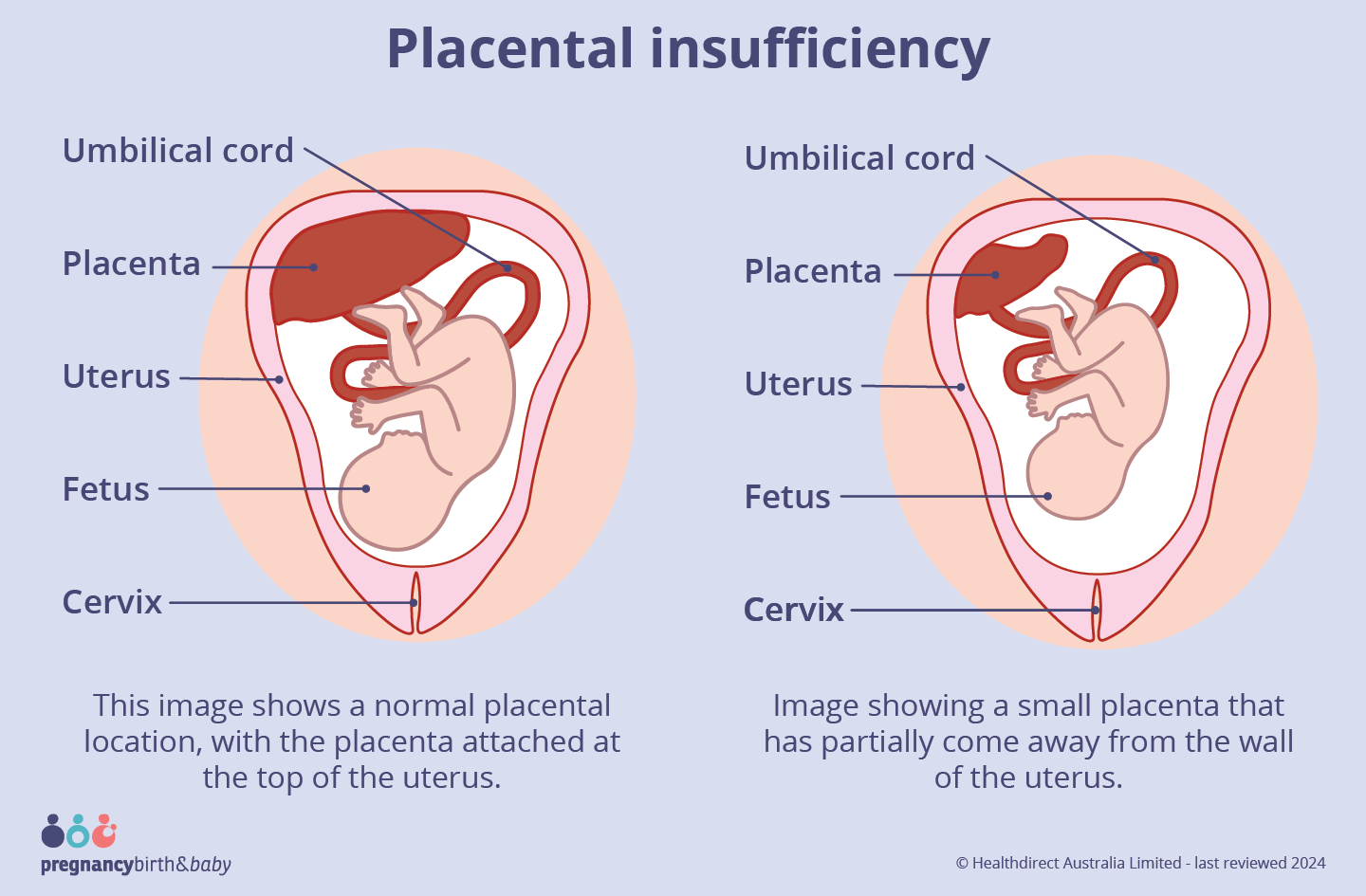
Illustration of normal placenta (left) and placenta insufficiency (right) during pregnancy.
Symptoms of placental insufficiency may be picked up during your routine antenatal visits and tests.
Signs may include slower than expected growth of your baby and reduced fetal movements.
You may notice that your tummy isn’t growing as your midwife or doctor expects. If you have been pregnant before, you may notice that your tummy is smaller than in previous pregnancies, or your baby isn’t moving as much. If you are worried, speak with your doctor or midwife.
There is often no obvious cause of placental insufficiency. It’s thought that the condition is caused by a problem during implantation of the placenta in your uterus. It can also happen if your placenta is damaged after implantation.
Risk factors for placental insufficiency include:
Other risk factors that can affect your baby's growth during pregnancy include:
However, the cause is not usually clear. It’s best not to dwell on what you could have done differently. Placental insufficiency is not your fault.
Placental insufficiency may be diagnosed during your routine antenatal visits and tests. A routine ultrasound can detect if your baby isn't growing as expected.
Your doctor or midwife will also measure and track the growth of your uterus and baby to make sure they are growing as expected.
An MRI scan (Opens in new tab) may be used to diagnose placental insufficiency in some cases.
Diagnosing placental insufficiency early is important for your health, as well as your baby's health. Sometimes placental insufficiency is only detected after the birth.
Diagnosing placental insufficiency early is important for your health, as well as your baby’s health. Sometimes placental insufficiency is only detected after the birth.
You may find it upsetting to find out about placental insufficiency. Perhaps you can no longer have the type of birth you hoped for.
It’s a good idea to talk through what the diagnosis means with someone.
If your pregnancy brings up difficult emotions, there are support services available, such as PANDA (Opens in new tab) (Perinatal Anxiety & Depression Australia) or COPE (Opens in new tab) (Centre of Perinatal Excellence).
Placental insufficiency can lead to problems for you and your baby.
Placental insufficiency increases your risk of pre-eclampsia and preterm labour.
If the placenta does not develop properly, your baby may experience problems including:
Babies with FGR may experience issues such as:
While there is no treatment to stop placental insufficiency, there are ways to manage it. Your options will depend on your situation, the stage of the pregnancy, your health and your baby’s health.
If your doctor suspects that you have placental insufficiency, they will closely monitor your baby’s growth and development. This might mean extra ultrasound scans. Your doctor or midwife can also monitor blood flow to the placenta. They may use a test called umbilical artery Doppler during the ultrasound.
They may monitor you and your baby more regularly and may recommend that you give birth in a major hospital with appropriate medical support, especially if you may need to give birth earlier than expected.
To improve your baby’s health, your doctor may recommend ways to maximise your chances of carrying the pregnancy to term. If there are signs that your baby is not well, they may recommend an induction of labour or a caesarean earlier than your due date.
If your baby hasn’t been growing as expected, they may need extra support from the medical team at birth. The medical team will care for your baby, keep them warm and may help them to breathe with an oxygen mask or breathing tube.
Your baby may need to spend some time in the special care nursery or neonatal intensive care unit (NICU) for extra care.
Your midwife and doctor will explain any tests and treatment that they recommend. You have a right to be informed, and it’s your choice to provide informed consent.
If you needed to give birth urgently because of placental insufficiency, you or your baby may need to recover for longer than expected in hospital.
Whether you had a vaginal or caesarean birth, recovery can be more difficult if your birth didn't go as planned. Talk with your midwife about what to expect.
If you experience unexpected problems during pregnancy and birth, you may feel disappointed, sad or distressed. It’s important to speak with your medical team about how you are feeling so they can help you and your family through your recovery.
How you feel after a pregnancy with complications, or a birth where medical interventions were used, is very individual. If you have previously experienced trauma, you have a right to trauma informed care.
Learn more about the emotional impact of birth trauma.
If you need to talk to someone about your mental health call Beyond Blue (Opens in new tab) on 1300 22 4636.
The Royal Australian and New Zealand College of Obstetricians and Gynaecologists has a leaflet about having a small baby (Opens in new tab).
You can get help and information from:

Call Pregnancy, Birth and Baby to speak to a maternal child health nurse on 1800 882 436 (Opens in new tab) or video call. Available 7am to midnight (AET), 7 days a week.
Find out how we develop and review our content.
Last reviewed: May 2026


