
Search our site for

Placental abruption
Key facts
- Placental abruption is when the placenta separates from the wall of your uterus before birth.
- The symptoms of placental abruption include vaginal bleeding, abdominal (tummy) pain and back pain.
- Placental abruption is a medical emergency — it can be very dangerous for both you and your baby.
- If you have any vaginal bleeding or sudden onset of abdominal pain during your pregnancy, it’s important to see your midwife or doctor as soon as possible.
- Treatment of placental abruption may include monitoring in hospital, bed rest, or sometimes, emergency birth of your baby.
What is placental abruption?
Placental abruption happens when the placenta partially or completely separates from the wall of your uterus (womb). It usually happens suddenly.
Placental abruption occurs in fewer than 1 in 100 pregnancies. It most often happens late in pregnancy.
While placental abruption is uncommon, it is a medical emergency. This is because your baby depends on the placenta for everything they need during pregnancy.
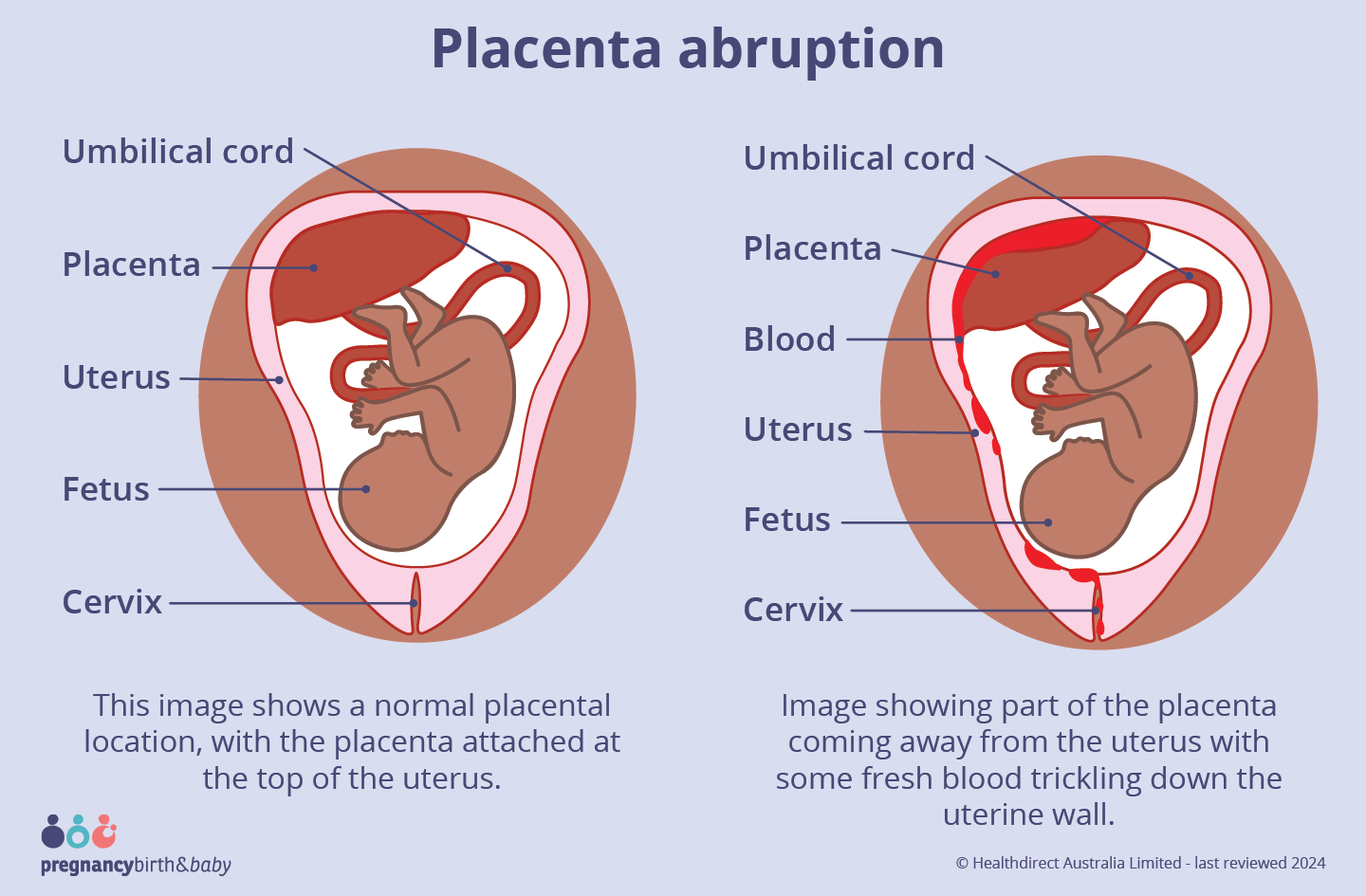
Illustration of normal placenta position (left) and placenta abruption (right) during pregnancy.
What are the symptoms of placental abruption?
Common symptoms of placental abruption include:
- vaginal bleeding
- abdominal (tummy) pain
- contractions — you may already be in labour
- lower back pain
- vaginal or pelvic pain
- your baby is moving less regularly
- dizziness
Most people who experience placental abruption have some vaginal bleeding. However, the amount of bleeding doesn’t necessarily reflect how bad the abruption is. In some cases, bleeding occurs behind the placenta and does not come out of your vagina.
If you have placental abruption, the pain tends to be constant, rather than coming in waves like contractions. The pain is usually severe, however you may only experience mild pain or even no pain at all.
Contact your midwife or doctor straight away and tell them about your symptoms.
What are the causes of placental abruption?
The cause of placental abruption is usually unknown, and it can’t usually be prevented.
In a minority of cases, a serious injury to the abdomen, such as a fall or car accident, is the cause of placental abruption.
Some pregnancy-related factors may increase your chance of placental abruption, including:
- gestational hypertension (high blood pressure during pregnancy)
- pre-eclampsia (a condition that causes high blood pressure during pregnancy)
- chorioamnionitis (an infection inside your uterus)
- placental abruption in a past pregnancy
- your waters breaking before 37 weeks of pregnancy
- a prior caesarean birth
- having twins or other multiple pregnancies
Other factors that may increase your chance of placental abruption include:
- smoking or vaping during pregnancy
- using illicit drugs, such as cocaine
- being pregnant when you are older
When should I see my doctor?
If you have any vaginal bleeding during your pregnancy, it’s important to see your midwife or doctor as soon as possible.
Vaginal bleeding during the last trimester of pregnancy is often due to a problem with your placenta.
It’s important to keep your routine antenatal appointments throughout your pregnancy. This helps your health team find and address any problems early, so you and your baby have the best chance of a safe and straightforward birth.
How is placental abruption diagnosed?
There is no single test that can be used to diagnose placental abruption. Your midwife or doctor may suspect placental abruption based on:
- your symptoms
- a physical examination
The physical examination will usually include, with your consent, an internal examination. If you are 37 or more weeks pregnant, they may ask to use an instrument called a speculum to check your cervix for bleeding. Tell your midwife or doctor if you do not want to have an internal examination.
Your midwife or doctor may recommend further tests to help diagnose or treat placental abruption:
- An ultrasound scan can rule out other causes of pain and bleeding, such as placenta praevia.
- Fetal heart monitoring with a cardiotocograph (CTG) can check for contractions and assess your baby’s general wellbeing — if this is abnormal, a caesarean is often recommended.
- You may be offered blood tests to check your haemoglobin levels and blood group — this is in case you need a blood transfusion.
How is placental abruption treated?
Placental abruption is a medical emergency that requires urgent assessment and treatment.
The treatment for placental abruption depends on:
- the health of your baby
- how far along your pregnancy is
- how severe the bleeding is
- your health
Partially separated placenta
If your placenta has only partially separated from your uterus and you have mild symptoms, your midwife or doctor may recommend close monitoring in hospital.
The bleeding from a partial placental abruption may resolve on its own. However, if the bleeding gets worse, you will be in the safest place for urgent treatment.
While in hospital, your healthcare team may:
- monitor your blood pressure, pulse, and the amount of fluid you have
- monitor your baby’s heart rate and overall health
- give medicines to help your baby’s lungs develop — this will help them breathe on their own if they need to be born early
Completely separated placenta
If your placenta has completely separated from the uterus, there is nothing your doctor can do to reattach it. This is a medical emergency and can be life-threatening to your baby if it’s not treated immediately. It usually happens suddenly and needs urgent treatment.
In most cases, you will need an emergency caesarean birth.
Rarely, an immediate vaginal birth may be possible if both you and your baby are stable.
Your midwife or doctor will discuss with you the options for treatment. They will recommend the safest course of action for you and your baby.
What are the complications of placental abruption?
Placental abruption is uncommon, but can have serious complications.
Complications of placental abruption for your baby include an increased chance of:
- neurological impairment (effects on the brain or nerves)
- growing more slowly than expected
- premature birth (birth before 37 weeks of pregnancy)
- stillbirth (the birth of a baby who has died)
If you have severe blood loss following placental abruption, you may experience hypovolaemic shock (dangerous blood loss) or kidney failure. You may need a blood transfusion or other treatments recommended by your medical team.
In very serious cases, placental abruption can be life-threatening.
What can I expect recovering from a birth with placental abruption?
If you needed to give birth urgently because of a placental abruption, you or your baby may need to recover for longer than expected in hospital.
Emotional support after a placental abruption
Placental abruption can happen very quickly and may be a traumatic experience for some parents and support people. It will probably take you some time to process what has happened. Many people find talking to others or writing down their experiences can help.
If you are dealing with difficult emotions after a placental abruption:
- talk to a midwife or maternal child health nurse about how you feel
- ask for practical and emotional support from friends and family
There are also support services available:
- You can call Beyond Blue on 1300 22 4636 to talk to someone about your mental health.
- The Australian Birth Trauma Association offers a peer support service and a support services directory.
- Perinatal Anxiety & Depression Australia (PANDA) offers support for new parents. Call the support line on 1300 726 306 to speak with a counsellor.
Learn more about the emotional impact of birth trauma.
If you are pregnant again in the future, it is a good idea to talk to your midwife or doctor about your fears and feelings. Healthcare services should provide trauma-informed care.
Resources and support
Western Sydney Local Health District has a range of factsheets about pregnancy, birth and baby, including placental abruption.
The Royal Women's Hospital has further information on placenta problems.
The Australian Birth Trauma Association offers information on:
The Centre of Perinatal Excellence (COPE) gives information on getting mental health help during pregnancy and has a list of support services.
Other languages
The Health Translations page has information about growing a healthy baby, in multiple languages.

Speak to a maternal child health nurse
Call Pregnancy, Birth and Baby to speak to a maternal child health nurse on 1800 882 436 or video call. Available 7am to midnight (AET), 7 days a week.
Find out how we develop and review our content.
Last reviewed: May 2026
Need more information?
Placental abruption | Better Health Channel
