
Speak to a maternal child health nurse
Call Pregnancy, Birth and Baby to speak to a maternal child health nurse on 1800 882 436 (Opens in new tab) or video call. Available 7am to midnight (AET), 7 days a week.

An epidural is a procedure where an anaesthetic (Opens in new tab) and other pain relief medicines are injected into your back, into the space around your spinal cord. This is called your epidural space. The injected anaesthetic will quickly numb your lower body. Epidurals offer relief from pain during contractions.
There are different options available for pain relief during labour. Pain relief preferences are different for everyone. It's a good idea to discuss your preferences with your doctor or midwife before your labour begins.
An epidural is usually given by an anaesthetist (a specialist doctor who gives anaesthetics for procedures).
Generally, after an epidural you won’t be able to walk but will be awake. A few large hospitals offer a walking epidural that allows you to move around during labour. If you choose to have an epidural, you will still be aware during the birth of your baby and be able to push your baby out.
Having an epidural does not make it more likely that you will need a caesarean section.
Before an epidural, you will usually have a cannula (drip) put into your arm. This is to provide you with intravenous (IV) fluids.
There are different positions that make it easier for the anaesthetist to put the needle into the right place. These include:
Your lower back will be cleaned with antiseptic. A local anaesthetic (Opens in new tab) injection will be given into your lower back. This makes the epidural procedure more comfortable for you. Some people say that the local anaesthetic feels like a bee sting when it goes in.
The epidural needle is the needle that your anaesthetist will insert between the bones of your spine into the space around your spinal nerves. It’s important that you stay very still during the procedure. Your anaesthetist will do this between contractions. You need to tell them when you have a contraction.
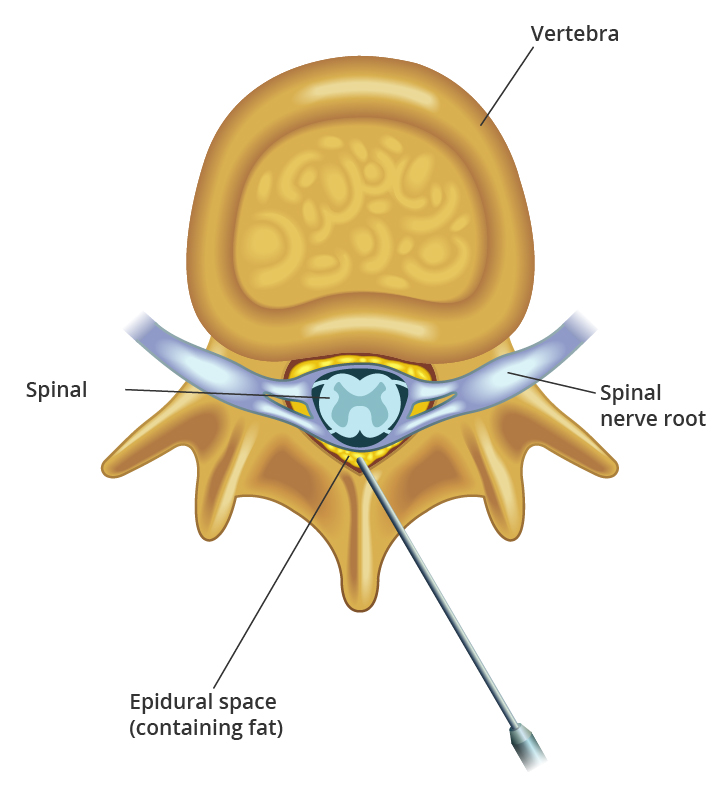
A diagram showing where an epidural needle is inserted.
The anaesthetist removes the needle and a very small, soft plastic tube (catheter) is left in your back. This allows anaesthetic medicines to be given to you during the labour. The tube will be removed after you give birth.
It usually takes between 25 to 40 minutes for the epidural to be set up and take full effect so that you are pain free.
It’s your choice if you want to have an epidural during your labour. Your doctor or midwife can explain the risks and benefits to help you make your choice. If other non-medical pain-relief methods aren’t enough, you may choose medical pain relief, such as an epidural.
You may choose an epidural at almost any time during your labour. You might change your mind about your preferences during labour.
An epidural may also be recommended if:
Your anaesthetist will ask for your consent before inserting an epidural.
When you have an epidural, you and your baby will be monitored continuously.
Epidurals can cause low blood pressure (Opens in new tab), so you will need to have your blood pressure monitored. You might also need to have fluids by an IV drip. Your baby will be closely monitored during your labour, using a cardiotocograph (CTG).
If you have an epidural, you won’t feel when you need to pass urine (wee). With most epidurals, you can’t stand or walk to the toilet. A urine catheter will be inserted into your bladder to drain your urine and keep your bladder empty. This can help prevent a full bladder from slowing your baby’s head from moving down into your pelvis.
While you will be able to move your legs with an epidural, you may not be able to bear weight (hold yourself up when you stand). This is why you will need to stay in bed to avoid falls. You can ask a nurse for help to get out of bed for the first time after an epidural.
You can choose to have an epidural at any stage of labour if there are no medical reasons that stop you from having one.
Most people can safely choose to have an epidural. However, there may be some medical reasons that mean it’s not possible. These can include:
In these situations, there may be other options available, such as a remifentanil pump.
Epidurals are available at most hospitals, but not in birth centres or during home births.
You should think about your options for pain relief before the birth. Your doctor or midwife can help you choose pain relief options that are suitable for you.
If you choose to have an epidural, there are several advantages. An epidural may:
If you are having a long labour, an epidural can allow you to sleep and recover your strength.
If you need an emergency caesarean, your epidural may mean you can stay awake for the birth of your baby. Extra anaesthetic medicines can also be given through the epidural, if you need them.
While an epidural is generally safe and effective, some risks include:
Epidural medicines do not harm your baby. While small amounts of the epidural medicines can cross the placenta, they are considered safe.
Epidurals can cause serious complications:
Speak to your doctor, midwife or maternal child health nurse about your questions and concerns around epidurals.
Some questions you may want to ask your healthcare professionals include:
You can talk with your midwife before labour and create a birth plan. They can help you understand the different pain relief options available to you. You can change your mind at any time, even while you are giving birth.
The pain relief that you choose, if any, during your labour is your decision. Your doctors and nurses are there to help you understand the procedures and any benefits and risks.
Different hospitals and birthing centres may have different maternity models of care. Ask your maternity care providers about the services available and how they can support the decisions you make about your labour.
Talk to your doctor, midwife or obstetrician about pain relief during labour.
You can find more information on pain relief during labour and making a birth plan.
For more support:
The Royal Women’s Hospital has information on pain during labour available in community languages (Opens in new tab).
The Australian and New Zealand College of Anaesthetists provides resources on pain relief during labour and birth (Opens in new tab) in many languages.

Call Pregnancy, Birth and Baby to speak to a maternal child health nurse on 1800 882 436 (Opens in new tab) or video call. Available 7am to midnight (AET), 7 days a week.
Find out how we develop and review our content.
Last reviewed: May 2026


