Skip to content
Pregnancy, Birth and Baby homeAustralian Government, Department of Health, Disability and Ageing (Opens in new tab)
Pregnancy, Birth and Baby home
Need to talk? Call 1800 882 436.
It's a free call with a maternal child health nurse. *call charges may apply from your mobile.
Is it an emergency? Dial 000
If you need urgent medical help, call triple zero immediately.
  1. Home/
  2. Labour and birth/
  3. When birth doesn't go to plan/
  4. Malpresentation

Malpresentation

Warning:

If your waters break and you have been told that your baby is not in a head-first position, seek medical help immediately.

Key facts

  • Malpresentation is when your baby is not in a head-first position towards the birth canal as birth approaches.
  • The most common type of malpresentation is breech — when your baby's bottom or feet are facing towards the birth canal.
  • A procedure called external cephalic version can be used to try and turn a breech baby into a head-first position after 36 weeks of pregnancy.
  • Most babies with malpresentation are born by caesarean, but some doctors or midwives may be able to help you birth a breech baby vaginally.
  • There is a serious risk of cord prolapse if your waters break and your baby is not in a head-first position.
  • On this page

    • What is presentation and malpresentation?
    • If my baby is not head-first, what position could they be in?
    • What is malposition?
    • What causes malpresentation?
    • What is the chance I will have a malpresentation?
    • How is malpresentation diagnosed?
    • Can my baby’s position be changed?
    • Will I need a caesarean if my baby has a malpresentation?
    • What are the risks if I have my baby when it’s not head-first?
    • Will I have a malpresentation in my future pregnancies?

    What is presentation and malpresentation?

    'Presentation' describes how your baby is facing down the birth canal. The 'presenting part' is the part of your baby's body that is against the cervix.

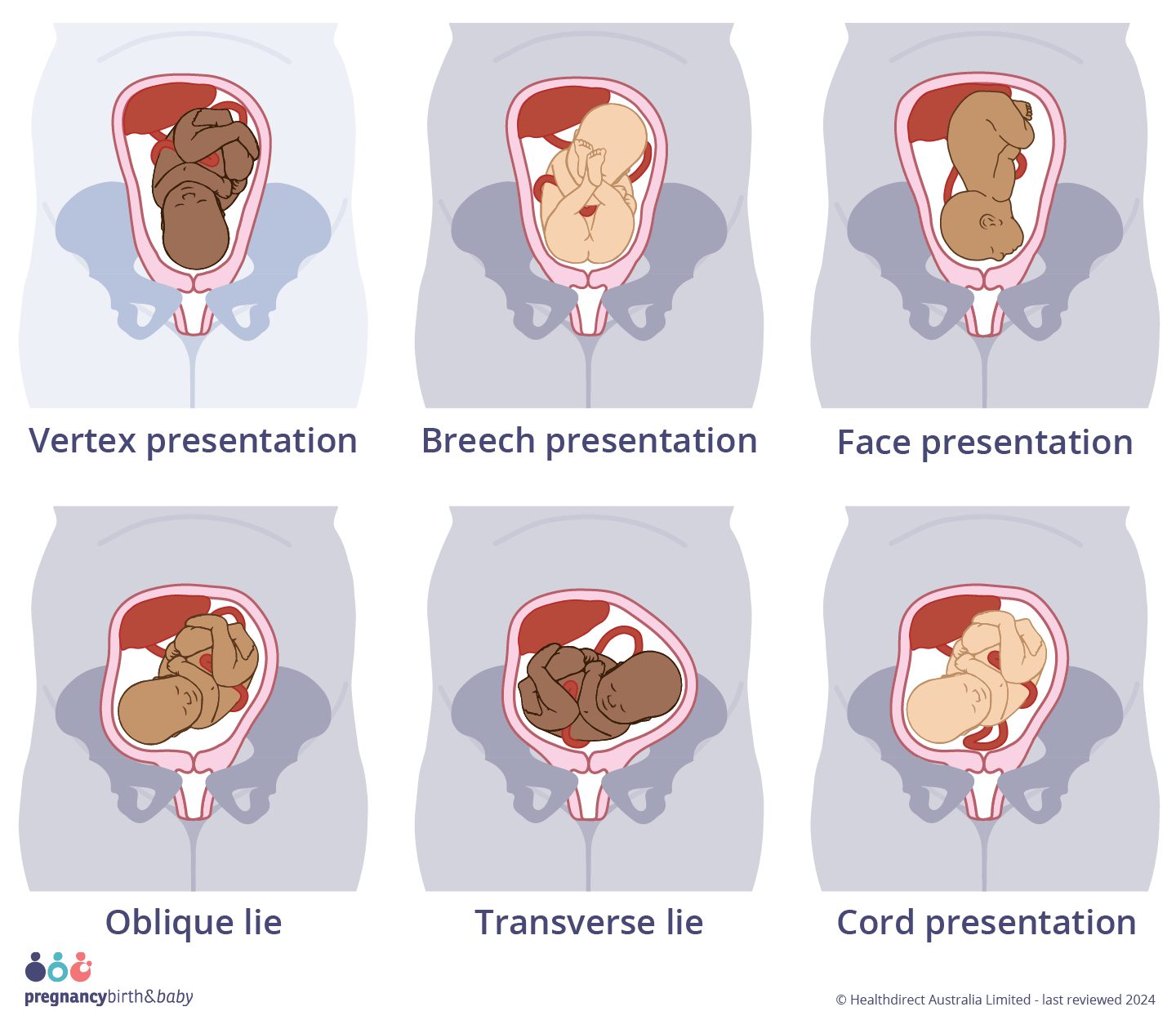
    The ideal presentation is head-first, where the crown (top) of the baby's head is against the cervix, and the chin tucked is into the baby's chest. This is called 'vertex presentation'.

    If your baby is in any other position, it's called 'malpresentation'. Malpresentation can mean your baby's face, brow, buttocks, foot, back, shoulder, arms or legs or the umbilical cord are against the cervix.

    It's safest for your baby's head to come out first. If any other body part enters the birth canal first, there is a higher risk of complications for both you and your baby. Malpresentation increases the chance that you will have a more complex vaginal birth or need a caesarean.

    If my baby is not head-first, what position could they be in?

    Malpresentation is caused by your baby's position ('lie'). There are different types of malpresentation.

    Breech presentation

    This is when your baby is lying with their bottom or feet facing down. Sometimes, one foot may enter the birth canal first (called a 'footling presentation').

    Breech presentation is the most common type of malpresentation.

    Face presentation

    This is when your baby is head-first, but stretching their neck, so their face is pressed against the cervix.

    Transverse lie

    This is when your baby is lying sideways. Their back, shoulders, arms or legs may be first to enter the birth canal.

    Oblique lie

    This is when your baby is lying diagonally. No particular part of their body is against the cervix.

    Unstable lie

    This is when your baby continually changes their position after 36 weeks of pregnancy.

    Cord presentation

    This is when the umbilical cord is against the cervix, between your baby and the birth canal. It can happen in any situation where your baby's presenting part is not sitting snugly in your pelvis. It can become a medical emergency if it leads to cord prolapse (when the cord comes down the birth canal before your baby, potentially reducing blood flow to your baby).

    Illustration of ideal presentation (vertex presentation, head-first) and malpresentations; Breech, face, transverse, oblique lie and cord presentation.

    Illustration of ideal presentation and five types of malpresentation.

    What is malposition?

    'Position' refers to which direction your baby is facing.

    If your baby is head-first, the best position for labour is with their face is towards your back.

    If your baby is head-first, but facing the front of your body (posterior position) or facing your side (transverse or lateral position) this is called malposition. It means your labour may take longer and you might feel more pain in your back. Babies who are malpositioned may move into a better position before or during labour.

    What causes malpresentation?

    Often, no cause is found, but malpresentation is more likely:

    • a low-lying placenta
    • too much or too little amniotic fluid
    • an abnormally shaped uterus or problems with the uterus, such as large fibroids (Opens in new tab)
    • many previous pregnancies, making the muscles of the uterus less stable
    • carrying twins or more

    Often, no cause is found.

    What is the chance I will have a malpresentation?

    Many babies maintain a breech position during pregnancy. They usually turn head-first as pregnancy progresses. More than 9 in 10 babies in Australia are in a head-first position at birth.

    You are more likely to have a malpresentation if:

    • this is your first baby
    • you've had a breech presentation in a past pregnancy
    • you go into labour prematurely

    How is malpresentation diagnosed?

    Your doctor or midwife can diagnose malpresentation by examining your abdomen and feeling the baby's position. If they aren't sure, it can be confirmed with an ultrasound.

    FIND A HEALTH SERVICE — The Service Finder can help you find doctors, pharmacies, hospitals and other health services.

    Can my baby’s position be changed?

    If your baby is still in a breech position when you are 36 weeks pregnant, it's less likely that they will turn head-first on their own. Your obstetrician may recommend a procedure called an called external cephalic version (ECV) to try and gently turn your baby to a head-first position.

    Some people try different postures, acupuncture (Opens in new tab) or moxibustion to correct malpresentation, but there is limited evidence that this work. Although if moxibustion is done before 37 weeks of pregnancy there is some evidence to suggest that this may reduce the chance of your baby being breech at birth. It's a good idea to talk to your maternity care provider before trying alternative therapies to understand what is right for you.

    Will I need a caesarean if my baby has a malpresentation?

    Most babies with a malpresentation close to birth are born by caesarean. If your baby is breech, you may be able to have a vaginal birth, but it's important that you are cared for in a hospital that can offer you and your baby specialised care. Ask your doctor or midwife for advice.

    If your baby is breech, an elective (planned) caesarean is safer for your baby than a vaginal birth in the short term. However, in the longer term their health will be similar, on average, regardless of how they were born.

    A vaginal birth is safer for you than an elective caesarean. However, about 4 in 10 people planning a vaginal breech birth end up needing an emergency caesarean. If this happens to you, the risk of complications will be higher than an elective caesarean.

    Your doctor can talk to you about your options. Whether it's safe for you to try a vaginal birth will depend on many factors, such as:

    • your baby's size
    • the position of your baby
    • whether you've had a caesarean in the past
    • the expertise of your doctor and the services available at your hospital

    What are the risks if I have my baby when it’s not head-first?

    This will vary based on your individual circumstance. Talk to your maternity care provider about what your baby's position means for your pregnancy, labour and birth. This will help you make informed decision that are right for you.

    If your waters break when your baby is not head-first, there is a risk of cord prolapse. This is a medical emergency.

    Warning:

    If your waters break and you have been told that your baby is not in a head-first position, seek medical help immediately.

    Vaginal breech birth

    Risks to your baby can include:

    • Erb's palsy (Opens in new tab)
    • fractures, dislocations or other injuries
    • bleeding in your baby's brain
    • low Apgar scores
    • their head getting stuck – this is a medical emergency

    Caesarean

    Risks to you include:

    • excessive blood loss
    • blood clots (Opens in new tab)
    • infection in the wound
    • problems with the anaesthetic
    • damage to other organs nearby, such as your bladder
    • a higher chance of complications in future pregnancies
    • a longer recovery time than after a vaginal birth

    Risks to your baby include:

    • trouble with breathing — this is temporary
    • getting a small cut during the surgery by accident

    Will I have a malpresentation in my future pregnancies?

    If you had a malpresentation in one pregnancy, you have a higher chance of it happening again. If you're worried, it may help to talk to your doctor or midwife.

    Speak to a maternal child health nurse

    Call Pregnancy, Birth and Baby to speak to a maternal child health nurse on 1800 882 436 (Opens in new tab) or video call. Available 7am to midnight (AET), 7 days a week.

    • Department of Health and Aged Care — Australian Pregnancy Care Guidelines (Opens in new tab)
    • Healthy WA — Breech presentation and turning the baby (Opens in new tab)
    • The Royal Australian and New Zealand College of Obstetricians and Gynaecologists — Breech presentation at the end of your pregnancy (Opens in new tab)
    • King Edward Memorial Hospital — Abnormalities of lie/presentation (Opens in new tab)
    • The Royal Women's Hospital — Baby’s position (Opens in new tab)
    • SA Health — Delays in the second stage of labour (Opens in new tab)
    • SA Health — Breech presentation (Opens in new tab)
    • SA Health — Cord presentation and prolapse (Opens in new tab)
    • Australian Institute of Health and Welfare — Australia's mothers and babies (Opens in new tab)
    • Safer Care Victoria — Breech presentation: diagnosis and management (Opens in new tab)
    • The Royal Australian and New Zealand College of Obstetricians and Gynaecologists — Caesarean section (Opens in new tab)

    Find out how we develop and review our content.


    Last reviewed: May 2024

    Need more information?

    These trusted information partners have more on this topic.

    Breech presentation and turning the baby

    In preparation for a safe birth, your health team will need to turn your baby if it is in a bottom first ‘breech’ position.
    WA Health logo
    Learn more on WA Health website

    Breech presentation at the end of your pregnancy

    RANZCOG logo
    Learn more on RANZCOG website

    External Cephalic Version for Breech Presentation

    This information brochure provides information about an External Cephalic Version (ECV) for breech presentation
    NSW Health logo
    Learn more on NSW Health website

    Breech Baby at Term Information about care options

    Breech Baby at Term Information about care options
    NSW Health logo
    Learn more on NSW Health website

    How to promote healthy eating for fussy children – Ngala

    Children, like adults, are attracted to certain textures, flavours and presentation. When we are children, appetite is a personal and innately well-controlled mechanism. Remember, the preschooler years are all about:...
    Ngala logo
    Learn more on Ngala website

    Other presentations

    Feeding and eating disorders are characterised by a persistent disturbance of eating or eating-related behaviour that results in the altered consumption or absorption of food and that significantly impairs physical health or psychosocial functioning.
    National Eating Disorders Collaboration logo
    Learn more on National Eating Disorders Collaboration website

    Promoting healthy eating with fussy toddlers – Ngala

    Children, like adults, are attracted to certain textures, flavours and presentation. Appetite is a personal and innately well-controlled mechanism in young children. Remember, the toddler years are all about: exploration...
    Ngala logo
    Learn more on Ngala website

    All past webinars | 1800RESPECT

    Webinars presented by 1800RESPECT and sector partners.
    1800Respect logo
    Learn more on 1800Respect website

    Working through pregnancy | COPE

    Working through pregnancy can present many challenges for some women.
    COPE logo
    Learn more on COPE website

    Depression - Information & Resources - Black Dog Institute | Better Mental Health

    Information about the signs and symptoms of depression, how they present in different people, and where to go to get help.
    Black Dog Institute logo
    Learn more on Black Dog Institute website

    Related pages

    • Breech pregnancy

    Search our site for

    • Caesarean Section
    • Foetal Version

    Find a health service

    Search now

    Need further advice or guidance from our maternal child health nurses?
    1800 882 436 Video call
    Logo for Pregnancy, Birth and Baby

    Pregnancy, Birth and Baby is funded by the Australian Government and operated by Healthdirect Australia.

    About

    About Pregnancy, Birth and BabyAbout our contentInformation partnersOur privacy commitmentTerms of useHow we use AIPromotional material

    Explore

    A to Z topicsDue date calculatorFind local health servicesGlossary of pregnancy and labourPregnancy and parenting in picturesPregnancy and baby appsSymptom Checker (Opens in new tab)

    Connect

    Contact usVideo callNewslettersLinking to us (Opens in new tab)Consumer engagement (Opens in new tab)

    Follow

    Australian Government, Department of Health, Disability and AgeingLogo for healthdirect Australia

    Pregnancy, Birth and Baby’s information and advice are developed and managed within a rigorous clinical governance framework (Opens in new tab).

    This site is protected by reCAPTCHA and the Google Privay Policy (Opens in new tab) and Terms of Service (Opens in new tab) apply.

    Healthdirect Australia acknowledges the Traditional Owners of Country throughout Australia and their continuing connection to land, sea and community. We pay our respects to the Traditional Owners and to Elders both past and present.

    © 2026 Healthdirect Australia Limited

    This information is for your general information and use only and is not intended to be used as medical advice and should not be used to diagnose, treat, cure or prevent any medical condition, nor should it be used for therapeutic purposes.
    The information is not a substitute for independent professional advice and should not be used as an alternative to professional health care. If you have a particular medical problem, please consult a healthcare professional.
    Except as permitted under the Copyright Act 1968, this publication or any part of it may not be reproduced, altered, adapted, stored and/or distributed in any form or by any means without the prior written permission of Healthdirect Australia.