Skip to content
Pregnancy, Birth and Baby homeAustralian Government, Department of Health, Disability and Ageing (Opens in new tab)
Pregnancy, Birth and Baby home
Need to talk? Call 1800 882 436.
It's a free call with a maternal child health nurse. *call charges may apply from your mobile.
Is it an emergency? Dial 000
If you need urgent medical help, call triple zero immediately.
  1. Home/
  2. Babies/
  3. Looking after your newborn/
  4. Getting out of the house with your new baby

Getting out of the house with your new baby

Key facts

  • It's a good idea to go out when your baby is calm and happy — after a feed and a nappy change is often a good time.
  • Keep your baby at the right temperature by dressing them for the weather.
  • Make sure your baby is protected from the sun.
  • Use a pram, stroller and car seat that meet the Australian and New Zealand Standard.
  • As much as possible, try to avoid seeing people who may be infectious while your baby is very young.
  • On this page

    • When is it safe to leave home with a new baby?
    • How should I dress my baby?
    • What should I take when I go out?
    • How can I transport my baby?
    • How can I protect my baby from sun damage?
    • How can I protect my baby from infectious diseases?
    • Resources and support
    Going outside into the fresh air and having a change of scene is good for both you and your baby. With a little planning, you can enjoy getting out with your newborn as soon as you like.

    When is it safe to leave home with a new baby?

    There is no rush to go on an outing with your new baby. In some cultures, women stay in the home with their new baby for a month or more.

    It's okay to take your baby outside as soon as you feel ready.

    It's a good idea to go out when your baby is calm and happy. After a feed and a nappy change is often a good time.

    If your baby was premature or has a health condition, speak with your doctor or child health nurse first.

    How should I dress my baby?

    It's important to keep your baby at the right temperature. You can check whether your baby is too warm or cold by feeling their forehead.

    Babies' hands and feet often feel cold when you touch them. So, don't judge their temperature by feeling their hands and feet.

    It's a good idea to dress your baby in layers that you can take off and put back on.

    Dressing your baby for cold weather

    If there's cold weather, keep your baby warm with a blanket and hat. When you come inside into the warm, take off 1 or 2 layers.

    Dressing your baby for hot weather

    If there's hot weather, you need to take special care to keep your baby cool and protect them from the sun.

    Babies can't cool themselves as well as adults and are more at risk of overheating. Dress your baby in minimal clothing on a hot day. But make sure their arms and legs are covered to prevent sunburn.

    A hat is essential to protect your baby's head and face from the sun.

    What should I take when I go out?

    Consider going on a short trip to start off with. Even for a short trip it's a good idea to be prepared. So, pack a bag in case your baby is hungry or needs a nappy change.

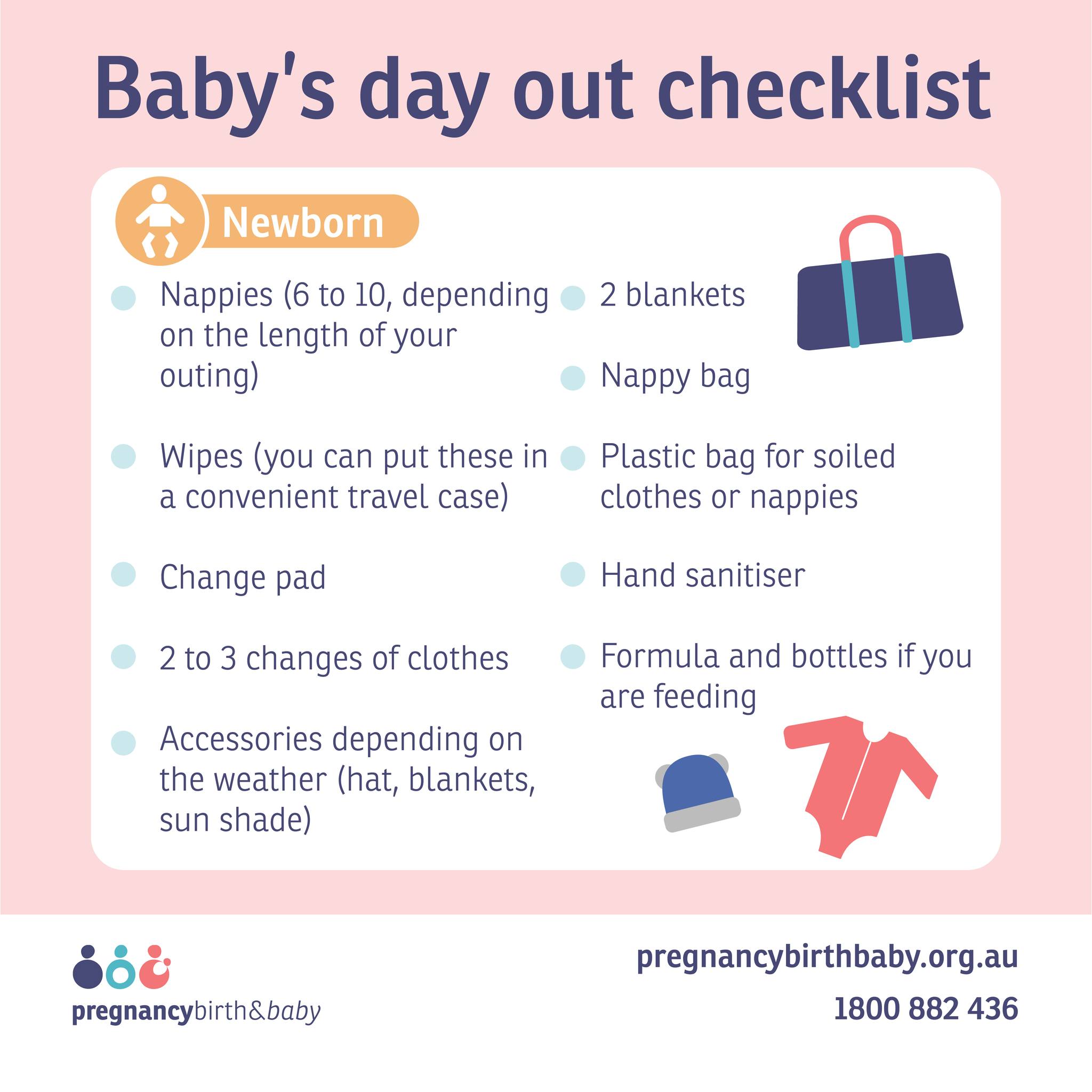
    Pack a bag with the following:

    • nappies (6 to 10, depending on the length of your outing)
    • wipes (you can put these in a travel case)
    • change pad
    • 2 to 3 changes of clothes
    • accessories, depending on the weather (hat, blankets, sun shade)
    • plastic bags for soiled clothes or nappies
    • hand sanitiser
    • formula and bottles if you are bottle feeding
    Baby's day out checklist

    How can I transport my baby?

    Pushing your baby in a pram or stroller is a good way for you to get out and about.

    Make sure your pram or stroller meets the mandatory Australian New Zealand Standard AS/NZS 2088:2000. And always secure your baby in your stroller with a 5-point harness.

    Make sure you always put on the brakes when you stop. You can prevent the pram from tipping by putting bags in the harness underneath, not over the handles.

    If you are driving somewhere, babies under 6 months must by law be restrained in an approved rear-facing car seat or capsule. All car seats in Australia must comply with Australian and New Zealand Standard AS/NZS 1754.

    How can I protect my baby from sun damage?

    It's important to protect your baby from the sun and high levels of UV radiation in Australia.

    Try to keep your baby in the shade at all times. Cover the pram with a cloth, but make sure air can still get through. Alternatively, you could use the pram's canopy top or an umbrella to create shade.

    Minimise use of sunscreen in babies younger than 6 months. If your baby will be exposed to the sun, apply sunscreen to the small areas of skin not covered by wraps, clothing and a hat.

    How can I protect my baby from infectious diseases?

    There are always infections in the community. These include gastroenteritis, colds and flu and COVID-19. As much as possible, try to avoid seeing people who may be infectious while your baby is very young.

    Immunisation will help protect your baby from some infections. Routine childhood vaccinations can be started from the age of 6 weeks.

    Resources and support

    Speak to a maternal child health nurse

    Call Pregnancy, Birth and Baby to speak to a maternal child health nurse on 1800 882 436 (Opens in new tab) or video call. Available 7am to midnight (AET), 7 days a week.

    • Cancer Council NSW — Sun protection for babies and children (Opens in new tab)
    • National Immunisation Program — National Immunisation Program Schedule (Opens in new tab)
    • Queensland Government — Immunisation is important for children (Opens in new tab)
    • Australian Competition and Consumer Commission — Prams and strollers – safety requirements (Opens in new tab)
    • Product Safety Australia — Pram and stroller safety (Opens in new tab)
    • The Royal Children's Hospital Melbourne — Safety: Child car seats (Opens in new tab)

    Find out how we develop and review our content.


    Last reviewed: July 2023

    Need more information?

    These trusted information partners have more on this topic.

    Can Babies Be Placed On Their Tummy To Play?

    Tummy play is safe and very important for babies from birth. Tummy play helps muscle development in the arms, neck and back. It can help prepare babies for crawling and sitting.
    Red Nose logo
    Learn more on Red Nose website

    My Baby Has Reflux

    Reflux is common for up to half of babies under three months of age, and 70% of healthy babies less than 1 year old. Most reflux stops after six months and completely stops within twelve months for 95% of babies.
    Red Nose logo
    Learn more on Red Nose website

    Babies' toys guide | ACCC Product Safety

    Babies can suffer a range of injuries from unsafe toys. Make sure you buy sturdy and well-made toys that are appropriate for a baby.
    ACCC Product Safety logo
    Learn more on ACCC Product Safety website

    WWWT Worksheets/Strategies: Understanding baby's crying

    A baby’s crying is very distressing to parents. It is not known why babies sometimes cry for long periods without being easily comforted. However, babies vary in the amount and intensity of crying in their first year. If babies are well fed and are not currently sick, prolonged crying might be related to being over-stimulated and over-tired. If your baby cries for periods of longer than five to ten minutes and your current soothing strategies do not seem help, perhaps your baby needs quietness and sleep.
    What Were We Thinking! logo
    Learn more on What Were We Thinking! website

    Why Do Babies Cry? | Karitane Tips for Soothing & Settling

    Learn why babies cry and how to soothe them with Karitane's expert advice. Understand hunger cues, sleep patterns, and settling techniques.
    Karitane logo
    Learn more on Karitane website

    Colic in babies: what it is & what to do | Raising Children Network

    Colic is when babies cry and fuss a lot for no obvious medical reason. It’s best to see a GP or nurse about colic. Looking after yourself is important too.
     logo
    Learn more on website

    Babies sleep | Raising Children Network

    Baby sleep patterns will probably change as your baby gets older. Our articles, videos and guides explain what to expect and how to handle baby sleep issues.
     logo
    Learn more on website

    Choking Hazards For Babies & Toddlers: How To Keep Children Safe In 2026 | Red Nose Australia

    Learn which everyday objects and toys pose choking hazards for babies and toddlers under three, and how to choose safe toys. Advice from Red Nose Australia and the ACCC.
    Red Nose logo
    Learn more on Red Nose website

    Baby Speech Development | Language Development | Tresillian

    Babies have an amazing capacity to learn and develop languages. Learn about baby speech development and language milestones.
    Tresillian logo
    Learn more on Tresillian website

    Babies: weaning | Raising Children Network

    If you're thinking about weaning your baby or stopping breastfeeding, our articles take you through key things to consider.
     logo
    Learn more on website

    Related pages

    • Babies in hot weather
    • Being at home with your baby after giving birth
    • Cleaning and sterilising baby bottles
    • Common myths about babies
    • Having a large baby

    Search our site for

    • Breastfeeding
    • Childbirth
    • Newborn Infants
    • Baby Clothes
    • Bottle Feeding

    Find a health service

    Search now

    Need further advice or guidance from our maternal child health nurses?
    1800 882 436 Video call
    Logo for Pregnancy, Birth and Baby

    Pregnancy, Birth and Baby is funded by the Australian Government and operated by Healthdirect Australia.

    About

    About Pregnancy, Birth and BabyAbout our contentInformation partnersOur privacy commitmentTerms of useHow we use AIPromotional material

    Explore

    A to Z topicsDue date calculatorFind local health servicesGlossary of pregnancy and labourPregnancy and parenting in picturesPregnancy and baby appsSymptom Checker (Opens in new tab)

    Connect

    Contact usVideo callNewslettersLinking to us (Opens in new tab)Consumer engagement (Opens in new tab)

    Follow

    Australian Government, Department of Health, Disability and AgeingLogo for healthdirect Australia

    Pregnancy, Birth and Baby’s information and advice are developed and managed within a rigorous clinical governance framework (Opens in new tab).

    This site is protected by reCAPTCHA and the Google Privay Policy (Opens in new tab) and Terms of Service (Opens in new tab) apply.

    Healthdirect Australia acknowledges the Traditional Owners of Country throughout Australia and their continuing connection to land, sea and community. We pay our respects to the Traditional Owners and to Elders both past and present.

    © 2026 Healthdirect Australia Limited

    This information is for your general information and use only and is not intended to be used as medical advice and should not be used to diagnose, treat, cure or prevent any medical condition, nor should it be used for therapeutic purposes.
    The information is not a substitute for independent professional advice and should not be used as an alternative to professional health care. If you have a particular medical problem, please consult a healthcare professional.
    Except as permitted under the Copyright Act 1968, this publication or any part of it may not be reproduced, altered, adapted, stored and/or distributed in any form or by any means without the prior written permission of Healthdirect Australia.