Skip to content
Pregnancy, Birth and Baby homeAustralian Government, Department of Health, Disability and Ageing (Opens in new tab)
Pregnancy, Birth and Baby home
Need to talk? Call 1800 882 436.
It's a free call with a maternal child health nurse. *call charges may apply from your mobile.
Is it an emergency? Dial 000
If you need urgent medical help, call triple zero immediately.
  1. Home/
  2. Pregnancy/
  3. Health conditions and complications/
  4. Hay fever during pregnancy

Hay fever during pregnancy

Key facts

  • If you're pregnant, you may experience hay fever or allergy symptoms.
  • Hay fever can cause an itchy, stuffy nose, sneezing, and watery eyes.
  • Allergy symptoms can be like the common cold, asthma, COVID-19, or pregnancy rhinitis.
  • While pregnant, you can prevent allergy symptoms by avoiding triggers that cause hay fever.
  • You can also ask your doctor or pharmacist about hay fever medicines that are safe to take while pregnant.
  • On this page

    • What is hay fever?
    • What causes hay fever?
    • Can pregnancy make me more sensitive to hay fever?
    • Can allergies or hay fever affect my baby?
    • How can I manage my hay fever while pregnant?
    • Can I prevent allergies?
    • What else could it be?
    • Resources and support

    What is hay fever?

    Hay fever (Opens in new tab) is a common health issue. It affects nearly 1 in every 5 people in Australia. Hay fever is also known as allergic rhinitis. Sometimes it is simply called 'allergies'.

    Symptoms of hay fever can be:

    • itchy, runny, swollen or blocked nose
    • sneezing
    • itchy, swollen or watery eyes

    Despite its name, the cause of hay fever does not have to be hay. It also, hay fever doesn't cause a fever.

    What causes hay fever?

    You may feel the symptoms of hay fever at certain times of the year. This is known as 'seasonal' allergic rhinitis. During the warmer months, certain triggers or 'allergens' can be found in the air. Examples are pollen from:

    • fungi
    • grasses
    • moulds
    • trees
    • weeds

    Hay fever with year-round symptoms is known as 'perennial' allergic rhinitis. Your triggers might also include common household allergens such as:

    • cockroaches
    • dander from animal fur (dog and cat fur)
    • dust mites
    • fungi
    • moulds

    Can pregnancy make me more sensitive to hay fever?

    Warning:

    If you have unexplained breathing problems, especially if they are severe and come on quickly, call triple zero (000) for an ambulance.

    During pregnancy you may find that:

    • you are more sensitive to your allergy triggers
    • your allergies are more troublesome

    The exact reasons for this aren't clear. It may be due to hormonal changes that happen in your body during pregnancy.

    Can allergies or hay fever affect my baby?

    Hay fever isn't dangerous to you or your baby. However, it can be very troublesome.

    Hay fever symptoms, such as a blocked nose, can prevent you from sleeping well. It's important that you sleep well during pregnancy.

    How can I manage my hay fever while pregnant?

    You can prevent allergy symptoms by avoiding any known triggers or allergens. This can be a tricky if you are not sure what you are allergic to.

    Your doctor may refer you to an allergy clinic for allergy testing (Opens in new tab). This can help find out what's causing your allergy symptoms.

    There are allergy medicines that are safe for you to take while you are pregnant. Some of these are:

    • antihistamine tablets and syrups (Opens in new tab)
    • eye drops
    • corticosteroid nasal sprays

    It's important that you are careful about the medicines you take during pregnancy. Some medicines may affect your unborn baby.

    Speak with your pharmacist or doctor. They can suggest hay fever medicines to ease your symptoms.

    Can I prevent allergies?

    You can't prevent allergies, but you can try to reduce your contact with allergens.

    Pollen is a common allergen in Australia. It can be hard to avoid because it's in the air. You can try to reduce your contact with pollen by:

    • staying indoors if possible during pollen season — especially on windy days, or after thunderstorms (Opens in new tab)
    • avoiding activities that give you contact with pollen, such as mowing grass
    • showering as soon as you can after you've been in contact with pollen
    • switching your car air-conditioning setting to use re-circulated air when pollen levels are high
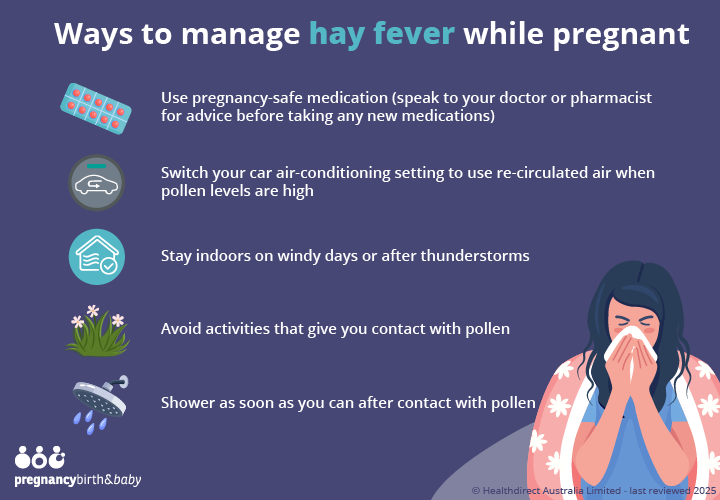
    Ways to manage hay fever while pregnant.

    Ways you can manage hay fever while pregnant.

    What else could it be?

    Symptoms of hay fever are like those of the common cold. But unlike a cold, hay fever is not caused by an infection. Hay fever is not contagious. Allergy symptoms tend to last longer than cold symptoms.

    Some COVID-19 symptoms (Opens in new tab) can also be like having hay fever. An example is a runny nose. If you test positive for COVID-19 while pregnant, contact your doctor or midwife for advice. Be sure to rest and stay hydrated.

    Another common condition in pregnancy is pregnancy rhinitis. Again, the symptoms are very similar to allergic rhinitis but are not caused by an allergic trigger. If you have pregnancy rhinitis, your symptoms will go away after your baby is born.

    People with allergies are also more likely to have asthma. Around 8 in every 10 people with asthma also have allergies. However, not everyone with allergies has asthma. Symptoms of asthma are:

    • wheezing (Opens in new tab) when breathing out (including after exercise)
    • a persistent cough (Opens in new tab) (especially at night)
    • shortness of breath (Opens in new tab)
    • chest tightness

    If you have any of these symptoms, ask your doctor whether it might be asthma.

    Resources and support

    For more information speak to your doctor or midwife about how you can treat hay fever during pregnancy.

    Speak to a maternal child health nurse

    Call Pregnancy, Birth and Baby to speak to a maternal child health nurse on 1800 882 436 (Opens in new tab) or video call. Available 7am to midnight (AET), 7 days a week.

    • Asthma Australia — Hay fever treatment (Opens in new tab)
    • Allergy & Anaphylaxis Australia — Allergic rhinitis (hay fever) (Opens in new tab)
    • Asthma in Pregnancy Toolkit — Focus on: Hayfever and allergies during pregnancy (Opens in new tab)

    Find out how we develop and review our content.


    Last reviewed: October 2024

    Need more information?

    These trusted information partners have more on this topic.

    Allergic Rhinitis (Hay Fever) - Australasian Society of Clinical Immunology and Allergy (ASCIA)

    Allergic Rhinitis (Hay Fever)
    ASCIA logo
    Learn more on ASCIA website

    Allergic Rhinitis (Hay Fever) and Sinusitis - Australasian Society of Clinical Immunology and Allergy (ASCIA)

    Allergic rhinitis, hay fever, sinusitis, pollen
    ASCIA logo
    Learn more on ASCIA website

    Allergic Rhinitis (Hay Fever) - Fast Facts - Australasian Society of Clinical Immunology and Allergy (ASCIA)

    Allergic Rhinitis (Hay Fever)
    ASCIA logo
    Learn more on ASCIA website

    Allergic rhinitis (hay fever) management and treatment - Allergy & Anaphylaxis Australia

    Tips and guidance about treatment options for allergic rhinitis (hay fever).
    Allergy and Anaphylaxis Australia logo
    Learn more on Allergy and Anaphylaxis Australia website

    Hay fever (allergic rhinitis) and… | National Asthma Council Australia

    Effective treatment for hay fever (allergic rhinitis) can help you keep your asthma under control.
    National Asthma Council Australia logo
    Learn more on National Asthma Council Australia website

    Allergic rhinitis (hay fever) - Allergy & Anaphylaxis Australia

    The above animation has been shared with permission from the National Allergy Council. The body’s immune system reacts to these common allergens which for most people are harmless. The immune system's response causes symptoms. Common symptoms include Runny nose Itchy nose Sneezing Itchy and watery eyes Blocked nose and snoring Some people need to clear their
    Allergy and Anaphylaxis Australia logo
    Learn more on Allergy and Anaphylaxis Australia website

    Hay fever | Better Health Channel

    Hay fever is an allergic reaction to airborne allergens that can occur at any time of the year.
    Better Health Channel logo
    Learn more on Better Health Channel website

    Pollen Allergy - Australasian Society of Clinical Immunology and Allergy (ASCIA)

    Pollen Allergy Frequently Asked Questions
    ASCIA logo
    Learn more on ASCIA website

    Hay Fever & Asthma Treatment Guide by Asthma Australia

    Asthma Australia shares expert tips to help manage hay fever & reduce asthma flare-ups. Discover treatment advice and start improving your symptoms today.
    Asthma Australia logo
    Learn more on Asthma Australia website

    Kids Health Info : Hay fever

    Royal Children's Hospital logo
    Learn more on Royal Children's Hospital website

    Search our site for

    • Allergy
    • Nasal Congestion

    Find a health service

    Search now

    Need further advice or guidance from our maternal child health nurses?
    1800 882 436 Video call
    Logo for Pregnancy, Birth and Baby

    Pregnancy, Birth and Baby is funded by the Australian Government and operated by Healthdirect Australia.

    About

    About Pregnancy, Birth and BabyAbout our contentInformation partnersOur privacy commitmentTerms of useHow we use AIPromotional material

    Explore

    A to Z topicsDue date calculatorFind local health servicesGlossary of pregnancy and labourPregnancy and parenting in picturesPregnancy and baby appsSymptom Checker (Opens in new tab)

    Connect

    Contact usVideo callNewslettersLinking to us (Opens in new tab)Consumer engagement (Opens in new tab)

    Follow

    Australian Government, Department of Health, Disability and AgeingLogo for healthdirect Australia

    Pregnancy, Birth and Baby’s information and advice are developed and managed within a rigorous clinical governance framework (Opens in new tab).

    This site is protected by reCAPTCHA and the Google Privay Policy (Opens in new tab) and Terms of Service (Opens in new tab) apply.

    Healthdirect Australia acknowledges the Traditional Owners of Country throughout Australia and their continuing connection to land, sea and community. We pay our respects to the Traditional Owners and to Elders both past and present.

    © 2026 Healthdirect Australia Limited

    This information is for your general information and use only and is not intended to be used as medical advice and should not be used to diagnose, treat, cure or prevent any medical condition, nor should it be used for therapeutic purposes.
    The information is not a substitute for independent professional advice and should not be used as an alternative to professional health care. If you have a particular medical problem, please consult a healthcare professional.
    Except as permitted under the Copyright Act 1968, this publication or any part of it may not be reproduced, altered, adapted, stored and/or distributed in any form or by any means without the prior written permission of Healthdirect Australia.