Speak to a maternal child health nurse
Call Pregnancy, Birth and Baby to speak to a maternal child health nurse on 1800 882 436 (Opens in new tab) or video call. Available 7am to midnight (AET), 7 days a week.


Vaccines are medicines that contain a tiny amount of a virus or bacteria. After you get a vaccine, your body makes antibodies designed to attack that specific virus or bacteria. If you are exposed to the disease in the future, your body recognises it and can produce antibodies more quickly. This helps your body fight the disease more effectively, sometimes even before you develop symptoms of the disease.
The Therapeutic Goods Administration (TGA) (Opens in new tab) approves vaccines for use in Australia. The TGA uses a strict process. This includes checking every ingredient in the vaccine for safety, quality and effectiveness.
Most vaccines are given by injection but some are given orally (by mouth).
Immunisation is the process of your body's immune system learning how to protect you from an infectious disease. Vaccination refers to when you receive the injection or oral dose of medicine.
Vaccination triggers immunisation in the body.
Video provided by the Department of Health, Disability and Ageing.
When there are high vaccination rates, vaccine-preventable diseases become less common in the community. This means even someone who is not vaccinated is less likely to catch the disease. This is called herd immunity.
Herd immunity is important for people who can't be or aren't yet vaccinated, especially:
Becoming immunised reduces the chance that these people will catch the disease.
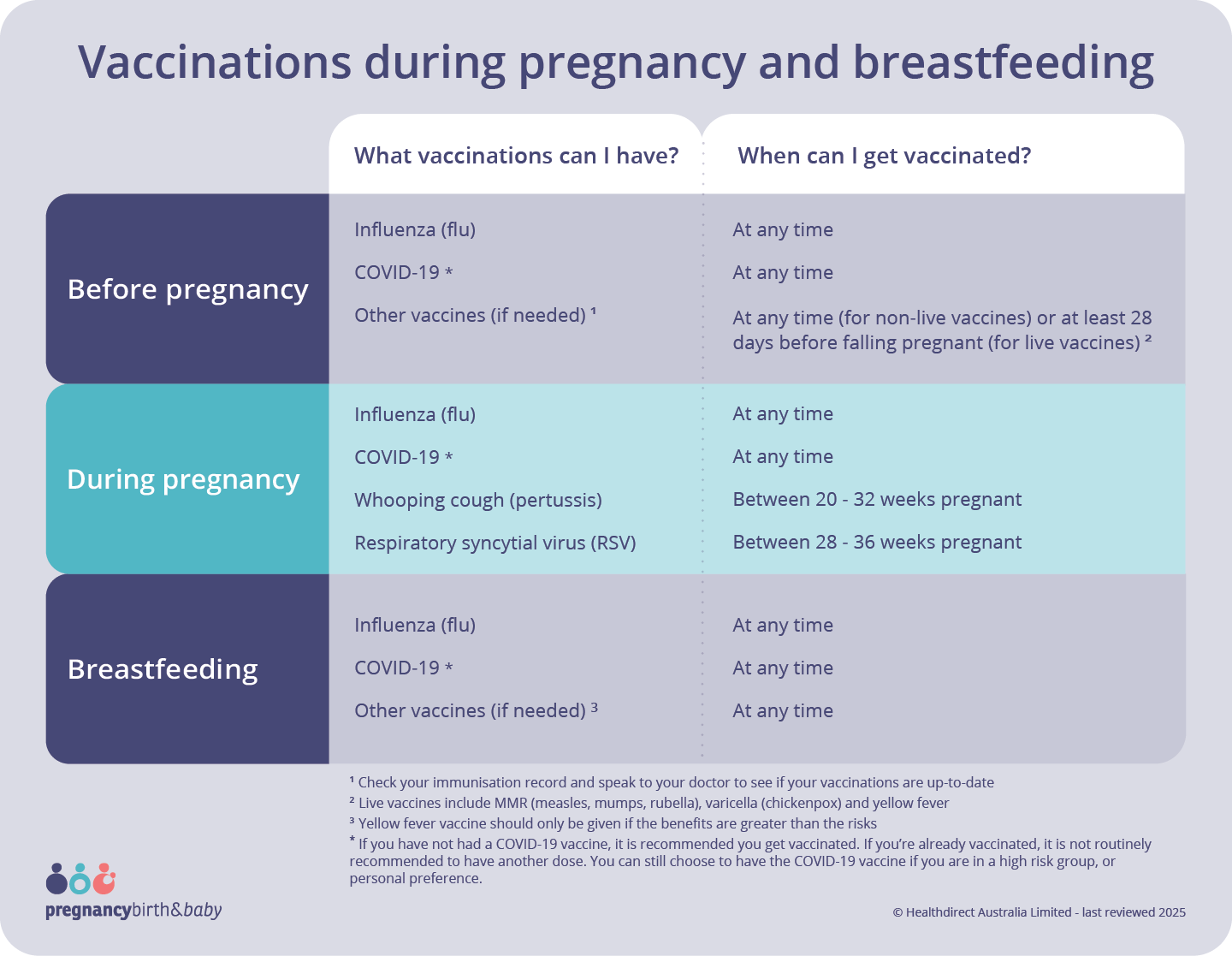
If you are planning to become pregnant, speak to your doctor about which vaccinations they recommend for you. They can check if you are up to date with certain vaccinations, such as:
Having these vaccinations can help protect both you and your future baby from these diseases.
To see what vaccinations you've had, you can check your immunisation history statement (Opens in new tab) on your myGov account or My Health Record, or ask your doctor.
Your doctor may refer you for a blood test to check your immunity levels against some of these diseases.
Vaccinations strongly recommended during pregnancy include those against:
These vaccinations are free under the National Immunisation Program (Opens in new tab). To be eligible for NIP vaccines, you must hold or be eligible for a Medicare card.
Vaccines recommended during pregnancy can help protect you from serious illness and complications while you're pregnant. They also provide early protection for your baby.
If you are already vaccinated for COVID-19, you do not need to be vaccinated again during pregnancy. You can still choose to have the COVID-19 vaccine if that is your preference, or if you are in a high risk group.
If you are travelling during pregnancy to certain countries, extra vaccinations might be recommended. If you have questions about vaccination during pregnancy, speak to your doctor or midwife.
Some vaccines are not recommended during pregnancy because they contain a tiny amount of live (but weakened) virus.
These include vaccinations against:
There is a very small chance that the live virus in the vaccine could pose a risk to your unborn baby. This is why it's recommended to check that you are up to date with all your vaccinations if you are planning a pregnancy. It's best to have these vaccinations at least 4 weeks before you become pregnant.
The human papillomavirus (HPV) vaccine is also not recommended during pregnancy. If you have started the course of HPV vaccines and become pregnant, you should continue the course only after your baby is born.
Before getting a vaccination, be sure to let your doctor or health professional know if you may be pregnant.
Side effects from vaccines are usually mild and short-lasting. You might have a sore arm or mild swelling where you had the injection. You may also have a mild fever or feel unwell.
Most mild side effects last only for a few days, and are part of the body's natural response to the vaccine.
Serious or long-lasting side effects are very rare.
Talk to your doctor about the side effects of the vaccine so you know what to expect.
The cost of vaccination in Australia varies.
Many vaccines are free under the National Immunisation Program (NIP) (Opens in new tab). The NIP includes a range of immunisations given throughout your life, from childhood to adulthood. You can access these if you have Medicare.
Your doctor or pharmacist may charge a fee to give the vaccine, even if the vaccine is free. It's a good idea to check the costs with your health provider when you book your appointment.
Australia has a national register for vaccinations. This is called the Australian Immunisation Register (AIR) (Opens in new tab). It helps you keep track of your and your child's immunisations.
You can get a list of your past vaccines from myGov (Opens in new tab), or ask your doctor. If you have Medicare, you will automatically be added to the AIR when you have any vaccines.
Vaccination is a personal choice, but an informed choice is always best. If you have questions or need more information about vaccines and pregnancy, you can speak with your doctor directly or call healthdirect on 1800 022 222 (known as NURSE-ON-CALL in Victoria).
Other Australian Government online resources include the following:
To find out what vaccines are recommended for you while you're pregnant, visit SKAI - Sharing Knowledge About Immunisation (Opens in new tab).
The Australian Government has videos and factsheets on vaccinations during pregnancy (Opens in new tab), available in many community languages.
Health Translations Victoria has brochures on the whooping cough (pertussis) vaccine during pregnancy (Opens in new tab) and on vaccine side effects (Opens in new tab), both available in many community languages.
The Australian Government has videos, fact sheets and posters on vaccination during pregnancy (Opens in new tab) for Aboriginal and/or Torres Strait Islander people.
NSW Health has information on which vaccinations are recommended for pregnancy (Opens in new tab) for Aboriginal and/or Torres Strait Islander people.

Call Pregnancy, Birth and Baby to speak to a maternal child health nurse on 1800 882 436 (Opens in new tab) or video call. Available 7am to midnight (AET), 7 days a week.
Find out how we develop and review our content.
Last reviewed: July 2025