Skip to content
Pregnancy, Birth and Baby homeAustralian Government, Department of Health, Disability and Ageing (Opens in new tab)
Pregnancy, Birth and Baby home
Need to talk? Call 1800 882 436.
It's a free call with a maternal child health nurse. *call charges may apply from your mobile.
Is it an emergency? Dial 000
If you need urgent medical help, call triple zero immediately.
  1. Home/
  2. Children/
  3. Sleep and your child/
  4. Children's nightclothes and safety

Children's nightclothes and safety

Key facts

  • Clothing that catches fire can cause serious burns and life-threatening injuries.
  • In Australia, children’s nightclothes must meet special fire safety standards.
  • All children’s nightwear sold in Australia has a label with fire danger information to help you make safer choices for your child.
  • The safest choice is close-fitting nightwear with a ‘low fire danger’ label.
  • When choosing clothes for babies and young children, consider their safety, practicality and comfort.

On this page

  • Why are there special guidelines about children's nightclothes?
  • What is the best fabric for children's nightclothes?
  • What is the best style for children's nightclothes?
  • Understanding labels
  • How can I prevent children’s nightclothes from catching fire?
  • What else should I consider when choosing clothing for babies and young children?
  • Resources and support

Why are there special guidelines about children's nightclothes?

Burns from clothing that catches fire can cause serious injury and even death.

In Australia, there are special rules for children's nightclothes. The labels on nightclothes can help you make safer choices for your child. Hospital visits for children due to burns have decreased since these rules were introduced.

What is the best fabric for children's nightclothes?

Almost any fabric can burn, but fabrics made with cotton and rayon burn more easily. Synthetic fibres, such as nylon, are slower to catch fire, but if they do, they melt and can stick to the skin. Silk and wool do not catch fire easily and they burn slowly.

The type of fabric and how it is made can affect how it burns when exposed to heat or flames. Fabrics that are fluffy, loose or have a raised surface can catch fire more easily and may allow flames to spread faster. 

Avoid loose or dangling features that could easily come into contact with flames or heat sources. Always keep clothing away from open flames and heat sources.

What is the best style for children's nightclothes?

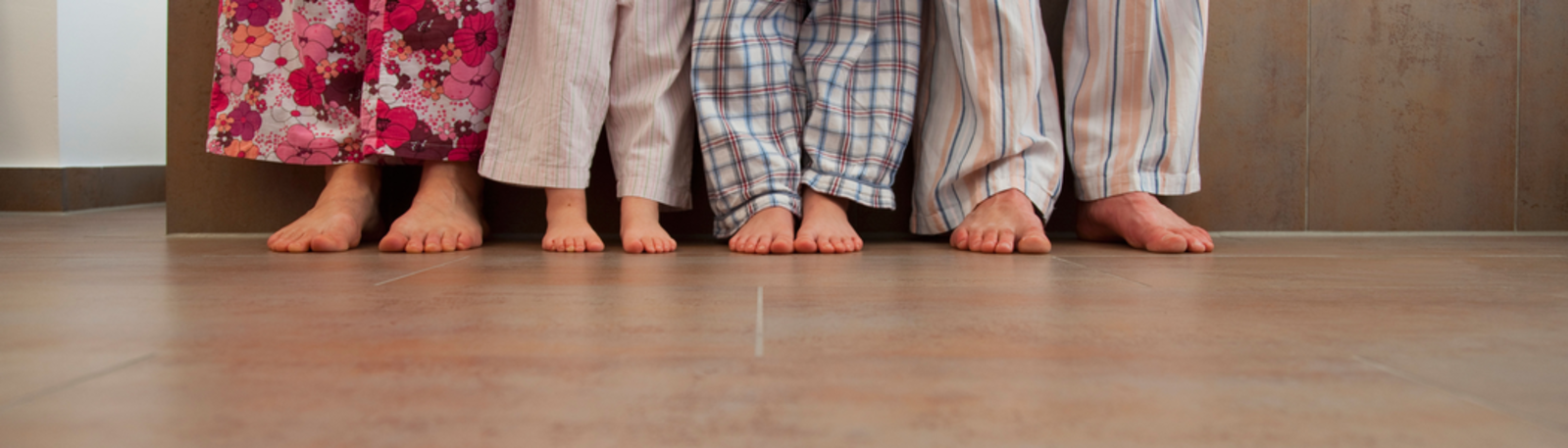
Long, loose-fitting clothing, such as nighties, can catch flames more easily. These nightclothes are a higher fire risk than close-fitting clothing. For this reason, closer-fitting nightwear is generally considered a safer option for children under Australian safety standards.

Understanding labels

There are 2 labels to help you when choosing children’s clothing:

  • Low fire hazard label — This means the garment is a lower fire risk. It is either made of a fabric that burns more slowly, or the garment is close fitting.
  • High fire hazard label — This means the garment is a high fire risk. Loose clothing and clothing made from some fabrics are at risk from open fires or heaters. 

Some garments are so flammable that they cannot be given a label and are not allowed to be sold in Australia.

Learn more about product safety standards for children's nightwear (Opens in new tab).

How can I prevent children’s nightclothes from catching fire?

Keep your child away from all sources of fire, including:

  • open fires
  • radiators
  • heaters
  • BBQs
  • candles
  • lighters and matches
  • cigarettes

When you use heaters or open fireplaces in winter, you need to be extra careful. Use a fireguard where appropriate to reduce the risk.

Once they are old enough, teach your child that if their clothing does catch fire, they should: STOP, COVER face, DROP and ROLL.

What else should I consider when choosing clothing for babies and young children?

Many parents like choosing clothing that looks nice and suits their baby or child’s style.

When choosing clothing for your baby or young child, there are other important things you should also consider, including safety and practicality for daily use.

Safety

Some features of baby and children’s clothing can be unsafe. They may increase the chance of:

  • choking
  • injury from sharp edges or points
  • strangulation (airway being squeezed) or entrapment (getting trapped)
  • danger from unsafe dyes or chemicals

When considering clothing for your child, here are some things to think about:

  • Are all small parts or trims, such as pom-poms, buttons or press-studs ('snap fasteners’), firmly attached?
  • Does the clothing have any drawstrings, cords or bows that could pose a strangulation risk?

Practicality

Here are some tips for choosing practical, comfortable clothing for your child:

  • Look for breathable, natural fibres such as wool.
  • All-in-one outfits (‘jumpsuits’ or ‘onesies’) will help keep your baby warm, stop their tummy from being exposed and allow easy access for nappy changes. Look for outfits with press-studs at the crotch or down the legs to make nappy and outfit changes even easier.
  • Look for jumpers with a boat neckline or envelope necklines. These are easier to put over your baby’s head than those with a smaller crew neck. You can also consider jackets with a front closure, such as snaps or buttons.
  • Most children do not need shoes until they start to walk. For older children, choose comfortable shoes that fit well with good grip.
  • Look for bibs with a hook-and-loop closure (for example, Velcro) — strings are more likely to get tangled.

Resources and support

Product Safety Australia (Opens in new tab) has information on children's nightwear safety standards, fire hazard labels and product recalls.

Kidsafe (Opens in new tab) has the latest information about child safety.

The Royal Children's Hospital Melbourne (Opens in new tab) has information on burns prevention and first aid for burns. 

Speak to a maternal child health nurse

Call Pregnancy, Birth and Baby to speak to a maternal child health nurse on 1800 882 436 (Opens in new tab) or video call. Available 7am to midnight (AET), 7 days a week.

  • Australian Competition and Consumer Commission — Nightwear for children mandatory standard (Opens in new tab)
  • Burns — Clothing-related burns in New South Wales, Australia: Impact of legislation on a continuing problem (Opens in new tab) (Harvey LA, et al.)
  • Northern Territory Government — Fire, electrical safety and children (Opens in new tab)
  • South Australian Metropolitan Fire Service — What To Do If Your Clothes Catch Fire (Opens in new tab)
  • Australian Competition and Consumer Commission — Children's nightwear guide (Opens in new tab)
  • J Environ Sci Health A Tox Hazard Subst Environ Eng — Human health risks from textile chemicals: a critical review of recent evidence (2019-2025) (Opens in new tab) (Rovira, J. et al.)
  • World J Plast Surg — An Observational Study on Clothing Characteristics Involved as Major Contributors in Sustaining Domestic Burns Injuries (Opens in new tab) (Thiitamaranahalli Muguregowda)

Find out how we develop and review our content.


Last reviewed: June 2026

Need more information?

These trusted information partners have more on this topic.

Safety apps for your digital devices | 1800RESPECT

Safety apps may help to increase your safety when using devices like mobile phones, iPhones and tablets. Each app has different information and services. You don't need to be experiencing violence or abuse to use a safety app.
1800Respect logo
Learn more on 1800Respect website

Safety gate guide | ACCC Product Safety

Safety gates help keep children safe. They restrict access to areas or objects that may be dangerous. Make sure they are always well secured.
ACCC Product Safety logo
Learn more on ACCC Product Safety website

Newborns safety | Raising Children Network

Newborn safety stressing you? Here’s all you need on newborns safety with articles, videos and resources on first aid, CPR, equipment, car seats and more.
 logo
Learn more on website

Safety at work | NT.GOV.AU

How to get work safety information and contact details for NT WorkSafe.
NT Health logo
Learn more on NT Health website

Safety planning | 1800RESPECT

Safety planning is thinking about things you can do to be safer when living with violence or abuse.
1800Respect logo
Learn more on 1800Respect website

Safety and injury prevention

Many childhood injuries and accidents can be prevented. Discover safety tips, information and resources.
Sydney Children's Hospitals Network logo
Learn more on Sydney Children's Hospitals Network website

Electrical safety at home | NT.GOV.AU

Find out about electrical safety in your home, including who to contact if you have concerns about work done on your property.
NT Health logo
Learn more on NT Health website

Vaccine safety | Australian Government Department of Health, Disability and Ageing

Find out how vaccines are developed, tested and monitored for safety in Australia.
Department of Health, Disability and Ageing logo
Learn more on Department of Health, Disability and Ageing website

Ensuring blood safety | Australian Red Cross Lifeblood

Safety is our number one priority and we’re really proud to have one of the world’s safest blood supplies.
Australian Red Cross Lifeblood logo
Learn more on Australian Red Cross Lifeblood website

Making a safety plan | MensLine Australia

A suicide safety plan is an important tool to protect yourself | Advice & support to create an effective plan for suicide prevention.
MensLine Australia logo
Learn more on MensLine Australia website

Search our site for

  • Injuries

Find a health service

Search now

Need further advice or guidance from our maternal child health nurses?
1800 882 436 Video call
Logo for Pregnancy, Birth and Baby

Pregnancy, Birth and Baby is funded by the Australian Government and operated by Healthdirect Australia.

About

About Pregnancy, Birth and BabyAbout our contentInformation partnersOur privacy commitmentTerms of useHow we use AIPromotional material

Explore

A to Z topicsDue date calculatorFind local health servicesGlossary of pregnancy and labourPregnancy and parenting in picturesPregnancy and baby appsSymptom Checker (Opens in new tab)

Connect

Contact usVideo callNewslettersLinking to us (Opens in new tab)Consumer engagement (Opens in new tab)

Follow

Australian Government, Department of Health, Disability and AgeingLogo for healthdirect Australia

Pregnancy, Birth and Baby’s information and advice are developed and managed within a rigorous clinical governance framework (Opens in new tab).

This site is protected by reCAPTCHA and the Google Privay Policy (Opens in new tab) and Terms of Service (Opens in new tab) apply.

Healthdirect Australia acknowledges the Traditional Owners of Country throughout Australia and their continuing connection to land, sea and community. We pay our respects to the Traditional Owners and to Elders both past and present.

© 2026 Healthdirect Australia Limited

This information is for your general information and use only and is not intended to be used as medical advice and should not be used to diagnose, treat, cure or prevent any medical condition, nor should it be used for therapeutic purposes.
The information is not a substitute for independent professional advice and should not be used as an alternative to professional health care. If you have a particular medical problem, please consult a healthcare professional.
Except as permitted under the Copyright Act 1968, this publication or any part of it may not be reproduced, altered, adapted, stored and/or distributed in any form or by any means without the prior written permission of Healthdirect Australia.