
Speak to a maternal child health nurse
Call Pregnancy, Birth and Baby to speak to a maternal child health nurse on 1800 882 436 (Opens in new tab) or video call. Available 7am to midnight (AET), 7 days a week.


Hearing loss can affect babies. Having hearing loss means that your baby has lost some or all of their hearing in one or both ears. Hearing loss in only one ear is called unilateral hearing loss.
It may be temporary or permanent. Hearing loss can be caused by different things, for example:
Hearing loss is described by:
Severe or profound hearing loss is also called deafness (Opens in new tab).
While all babies develop differently, signs of hearing loss may include not meeting some of their developmental milestones.
Some milestones to look out for include:
Other possible signs of hearing loss are when your baby:
Speak to your baby’s doctor or child health nurse if your baby:
If you think your baby might have signs of hearing loss, see your baby’s doctor or child health nurse.
The type of hearing loss depends on which part of your ear is affected.
The different parts of the ear (Opens in new tab) are the:
The outer and middle ear send soundwaves to the inner ear. In the inner ear, sounds are converted to messages that are sent to your brain through the auditory (hearing) nerve.
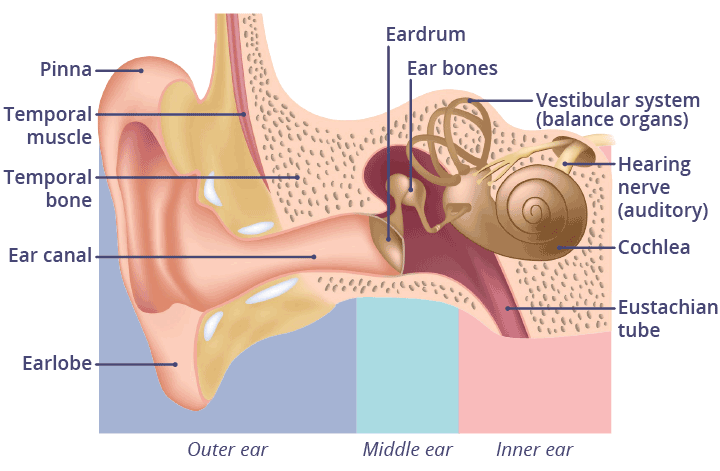
The different parts of the ear: outer ear, middle ear and inner ear.
There are 3 types of hearing loss:
Conductive hearing loss happens when there is a problem with the outer or middle parts of the ear. This prevents the soundwaves from reaching the inner ear properly.
Conductive hearing loss is usually temporary, but sometimes can be permanent.
Sensorineural hearing loss is caused by a problem in the inner ear or with the auditory nerve.
It is usually permanent.
Mixed hearing loss involves having both conductive and sensorineural hearing loss.
Conductive and sensorineural hearing loss can be caused by different things.
Temporary conductive hearing loss can be caused by:
Ear infections are common in babies. Most ear infections will get better on their own in 2 to 3 days. After this time, you should take them to see a doctor.
Conductive hearing loss may be permanent if your baby's ear bones or ear canal are:
Sensorineural hearing loss can be caused by:
Problems with the inner ear may also be linked to:
The most common non-genetic cause of sensorineural hearing loss in babies is cytomegalovirus (CMV) during pregnancy.
Sensorineural hearing loss is often permanent.
In Australia, babies have their hearing tested soon after birth. Most newborns are tested before they leave hospital to see if they need further testing.
The newborn hearing screening test is a free test that measures your baby’s responses to different noises.
During the test, your baby will be given a headset that plays noises in both their ears.
Sensors placed on their skin can check their nervous system’s response to these sounds.
Results of the screening hearing test are either pass or refer:
A refer result on the newborn hearing screening test does not mean that your baby has permanent hearing loss. It just means they need more tests to check their hearing.
If you think your baby has hearing loss that was not detected in the newborn hearing screening test, take them to your doctor. They will examine your baby and may refer them to a specialist, such as:
Understanding the cause of hearing loss will help your healthcare team plan the best treatment for your baby.
Hearing loss can be difficult to recognise in babies. Occasionally, hearing loss is not detected during newborn hearing screening. If you think that your baby may be having trouble hearing, speak to your doctor or child health nurse.
Treatment of hearing loss depends on its cause and severity. Detecting hearing problems early and starting the right treatment can help your baby achieve the best possible outcomes. With early diagnosis and appropriate support, many babies with hearing loss go on to develop language and communication skills well.
If your child has hearing loss, you may choose to use technologies to help improve their hearing. Depending on the cause of their hearing loss, these may include:
Services and hearing professionals are available to help your baby develop skills alongside their hearing loss as they get older. The most important thing for your baby's development is their ability to communicate with others.
If your baby has an ear infection, they may be given medicines such as antibiotics (Opens in new tab). If your baby has repeated ear infections, your doctor may recommend grommets (Opens in new tab). Grommets are tubes that help the fluid drain out of their ears.
Babies and children with hearing loss need to have their development checked as they grow. This can include having regular:
Recognising your baby’s hearing loss early can help you understand their needs and access the support they need to connect with the world around them.
You can help prevent hearing loss by protecting your baby’s ears from infection and loud noises.
You can also prevent hearing loss caused by some types of infection by vaccinating your child against:
If you are pregnant or planning to become pregnant, make sure to wash your hands well and avoid sharing food or drinks with children to reduce the risk of CMV infection. Breastfeeding can also help protect your baby against infections.
If your baby gets an ear infection, ask your doctor how to treat it to prevent hearing loss.
Use ear protection for your baby’s ears, like earmuffs, when they are around loud noises like:
Hearing loss can affect your child’s language and speech development. With early diagnosis and support, many babies develop these skills well.
Sometimes conditions that affect the inner ear can also affect balance.
Diagnosing hearing loss early and starting the right support can reduce the chance of developmental delays.
Learning that your baby has hearing loss can feel overwhelming. Support groups and healthcare professionals can help you understand your baby's needs, answer your questions and connect you with services and other families.
You can read more about ear infections in children.
For more information on hearing loss:
Learn more about raising a deaf child.
Find out more about protecting your baby’s ears from loud noises (Opens in new tab).
If you live in Queensland or Northern NSW, you can contact the Healthy Hearing Family Support Service (Opens in new tab) for support.

Call Pregnancy, Birth and Baby to speak to a maternal child health nurse on 1800 882 436 (Opens in new tab) or video call. Available 7am to midnight (AET), 7 days a week.
Find out how we develop and review our content.
Last reviewed: June 2026



