Skip to content
Pregnancy, Birth and Baby homeAustralian Government, Department of Health, Disability and Ageing (Opens in new tab)
Pregnancy, Birth and Baby home
Need to talk? Call 1800 882 436.
It's a free call with a maternal child health nurse. *call charges may apply from your mobile.
Is it an emergency? Dial 000
If you need urgent medical help, call triple zero immediately.
  1. Home/
  2. Children/
  3. Disability and chronic illness/
  4. Asthma in children under 6

Asthma in children under 6

Warning:

Asthma can be life-threatening — if your child is finding it hard to breathe, take them to the nearest hospital emergency department or call triple zero (000) for an ambulance.

Key facts

  • Asthma is a respiratory (lung) condition that can make your child's airways become narrow at times.
  • The symptoms of asthma include wheezing, difficulty breathing and coughing.
  • In children, the most common trigger for asthma is a viral infection, such as a cold.
  • Your doctor can usually diagnose asthma, and may recommend your child starts a treatment to help with their symptoms.
  • It's important that your child has a written asthma action plan — this will help you manage their asthma and know what to do if they have an asthma attack.
  • On this page

    • What is asthma?
    • What are the symptoms of asthma in children?
    • What causes asthma?
    • When should I see my doctor?
    • How is asthma diagnosed?
    • How is asthma treated?
    • Managing an acute asthma attack
    • Can asthma be prevented?
    • What are the complications of asthma?
    • Should my child with asthma be active?
    • Resources and support

    What is asthma?

    Asthma is a respiratory condition that causes your child's airways to become narrow. This is due to:

    • the lining of their airways becoming swollen and inflamed
    • the layer of muscle inside their airways becoming tight
    • their airways being blocked by mucus

    Asthma affects 1 in 5 children.

    Wheezing is the most common symptom of asthma in children under 5 years of age. Wheezing is a high-pitched sound coming from your child's chest when they breathe in and out.

    Not all children with wheezing have asthma. In children younger than 12 months of age, wheezing is usually caused by bronchiolitis (lung infection).

    What are the symptoms of asthma in children?

    Symptoms of asthma in children can include:

    • wheezing — this is most noticeable when your child breathes out
    • coughing — this often occurs at night or when waking up in the morning
    • difficulty breathing — you may notice the skin above your child's collarbone being sucked in as they breathe
    • breathing faster than normal
    • chest tightness — this is when your child's breathing seems 'tight' or they are short of breath

    Your child doesn't have to have all these symptoms to have asthma.

    The symptoms of asthma can range from mild to severe.

    CHECK YOUR SYMPTOMS — Use the Symptom Checker and find out if you need to seek medical help.

    What causes asthma?

    The exact cause of asthma is not known.

    Asthma can be genetic, which means many children with asthma have a family history of asthma.

    Asthma symptoms can be triggered by many things. The most common trigger is an infection, such as a cold or the flu.

    Your child's symptoms may be triggered by an allergy to:

    • pollen
    • animal dander (dead skin and fur), usually from pets
    • mould

    Other triggers for asthma include:

    • exercise
    • cold, dry air
    • changes in the air environment (such as thunderstorms and bushfire smoke)
    • cigarette smoke
    • air pollution

    You can prevent asthma symptoms by helping your child avoid triggers.

    When should I see my doctor?

    You should see your doctor if your child has wheezing, or other symptoms of asthma.

    When to seek urgent care

    Warning:

    If your child is finding it hard to breathe, take them to the nearest hospital emergency department or call triple zero (000) for an ambulance.

    Get urgent medical attention if your child:

    • is not breathing
    • is having difficulty breathing — you may notice your child breathing rapidly or moving their chest a lot
    • is unable to speak normally
    • has slightly blue lips — this is a sign that not enough oxygen is reaching their body
    • is having an asthma attack and a reliever is not available
    • has asthma symptoms that do not get better with asthma medicines
    • is distressed or confused

    A severe asthma attack can be very upsetting because your child will feel like they can't get enough air.

    FIND A HEALTH SERVICE — The Service Finder can help you find doctors, pharmacies, hospitals and other health services.

    How is asthma diagnosed?

    Your doctor can usually diagnose asthma.

    Your doctor will ask about your child's symptoms. Your doctor will also want to know:

    • what brings on your child's symptoms
    • what time of day your child has symptoms
    • how often your child has symptoms
    • about your child's general health, including any allergies
    • whether your child is exposed to smoke in your home
    • whether anyone in your family has asthma or allergies
    • what helps with your child's symptoms

    Your doctor will examine your child and listen to their breathing with a stethoscope. They may also check your child's heart rate and blood pressure.

    If your doctor is unsure what is causing your child's symptoms, they may suggest getting a chest x-ray. They may also refer your child to a paediatrician (children's doctor).

    If your doctor thinks that your child has asthma, they may recommend a treatment trial. This means they will give your child asthma medicines, to see if this helps with your child's symptoms.

    How is asthma treated?

    There are 2 main types of asthma medicines, known as 'relievers' and 'preventers'.

    Relievers

    These can help reduce your child's asthma symptoms when they happen. The most common reliever medicine is salbutamol (a well-known brand is Ventolin).

    All children should use reliever medicine to help with severe asthma symptoms or an asthma attack, even if they also take preventer medicine.

    Preventers

    These help reduce how often your child has asthma symptoms. Preventers can be used in children with asthma who have:

    • symptoms that happen regularly (like having daytime symptoms twice a week or more)
    • symptoms that make it hard for them to play or sleep
    • 2 or more flare-ups while taking other oral asthma medicines

    Preventer medicines need to be taken every day, even when your child is feeling well. Some preventer medicines are taken as inhalers (breathed in through the lungs), while others are taken as a tablet.

    Asthma medicines are often taken using an inhaler and a device called a spacer. It's important to learn how to use an inhaler and spacer properly.

    Your child will need regular follow-up visits with your doctor. This is to check on their symptoms and decide if they still need treatment. It can be helpful to write down what caused your child's symptoms and when they took their asthma medicine. This can help your doctor work out if changes to medicines are needed.

    Asthma action plan

    Ask your doctor to create a written asthma action plan for your child. An asthma action plan helps you manage your child's asthma. It lists:

    • your child's usual medicines
    • when and how your child should take their medicine
    • what to do if your child's symptoms get worse
    • what to do in the case of an asthma emergency

    Share your child's asthma action plan with everyone who cares for your child, including:

    • childcare workers
    • friends
    • family members

    LOOKING FOR A MEDICINE? — To search by brand or active ingredient, use the Medicines information search feature.

    Managing an acute asthma attack

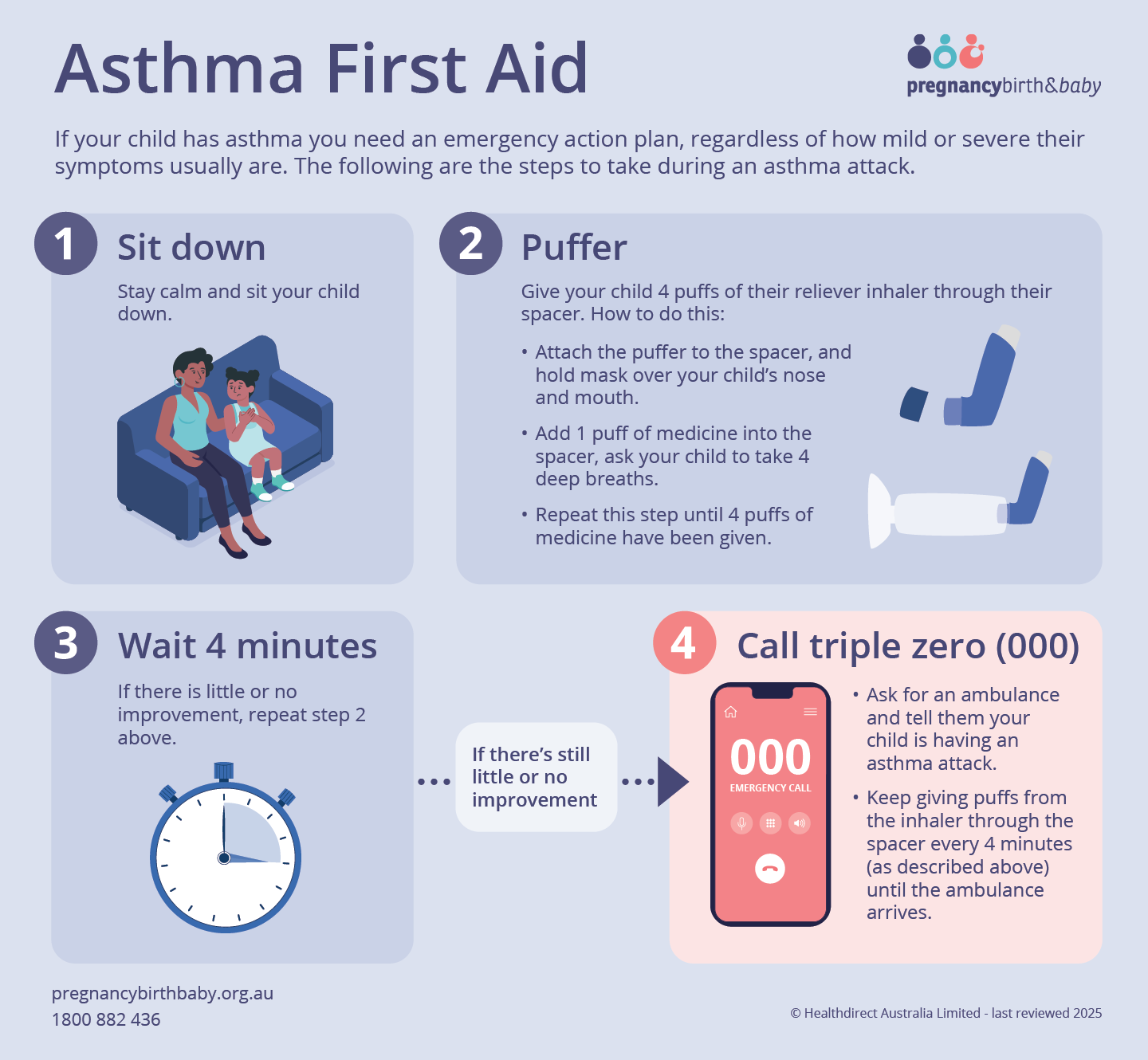
    If your child has asthma, you need an emergency action plan, even if their symptoms are usually mild.

    If your child has a severe asthma attack:

    1. Stay calm and sit your child down.
    2. Put 1 puff into their spacer. Give your child 4 breaths of their reliever inhaler through their spacer.
    3. Repeat this process until 4 separate puffs have been taken.
    4. Wait 4 minutes. If there is little or no improvement, repeat step 2.
    5. If there is still little or no improvement after 4 minutes, call triple zero (000) and ask for an ambulance. State that your child is having an asthma attack.

    While waiting for the ambulance to arrive, give your child puffs from the inhaler through the spacer as instructed above. Wait 4 minutes and do it again. Repeat this until the ambulance arrives.

    An illustration showing the steps of managing an acute asthma attack.

    Click to view this image in full: Asthma first aid guide.

    Can asthma be prevented?

    Asthma can't be prevented entirely, but there are ways to lower your child's chance of having asthma symptoms.

    You should avoid smoking and exposure to cigarette smoke while pregnant. Smoking and breathing in second hand smoke during pregnancy can affect your baby's lungs. This can increase your child's chance of having asthma.

    Asthma symptoms can sometimes be prevented by avoiding triggers. For example, if you know that animal dander (dead skin and fur) triggers your child's asthma, reducing animal hair in your home can help.

    It's recommended that your child is up to date with their vaccinations. This can help protect them from respiratory infections, which can cause asthma symptoms. Talk to your doctor or child health nurse about which vaccinations your child may need.

    What are the complications of asthma?

    Children with asthma can have severe symptoms or asthma attacks.

    Children with severe asthma symptoms may need to go to hospital for treatment. In some cases, severe asthma symptoms can cause respiratory failure (lung failure).

    It's important to manage your child's asthma well to help prevent severe asthma symptoms and asthma attacks.

    Should my child with asthma be active?

    It's important for children with asthma to be active. This will help them stay fit and healthy.

    Talk with your doctor about how to prevent and manage asthma symptoms when your child is active. Your child's asthma action plan will help with this.

    Resources and support

    The National Asthma Council's (Opens in new tab) Australian Asthma Handbook has:

    • information on diagnosing asthma in children 1 to 5 years of age (Opens in new tab)
    • a summary of asthma management in children 1 to 5 years of age (Opens in new tab)

    Asthma Australia (Opens in new tab) has:

    • a first aid fact sheet (Opens in new tab) on what to do if your child has an asthma attack
    • information on what is included in an asthma action plan (Opens in new tab)
    • resources in languages other than English (Opens in new tab)
    • videos on how to use your medicines (Opens in new tab)

    Call the Asthma Australia Information Line (Opens in new tab) on 1800 278 462 to talk to an Asthma Educator.

    Log on to the Asthma Buddy app (Opens in new tab) to help keep track of your child's symptoms.

    You can call the healthdirect helpline on 1800 022 222 (known as NURSE-ON-CALL in Victoria). A registered nurse is available to speak with you 24 hours a day, 7 days a week.

    Speak to a maternal child health nurse

    Call Pregnancy, Birth and Baby to speak to a maternal child health nurse on 1800 882 436 (Opens in new tab) or video call. Available 7am to midnight (AET), 7 days a week.

    • Asthma Australia — Asthma guidelines for Australian Schools (Opens in new tab)
    • Asthma Australia — Health Futures for Kids with Asthma (Opens in new tab)
    • Children's Health Queensland — Asthma – Emergency management in children (Opens in new tab)
    • National Asthma Council — Smoking triggers my asthma and allergies (Opens in new tab)
    • Asthma Australia — Asthma first aid: What to do during an attack (Opens in new tab)
    • National Asthma Council — Managing acute asthma in children 1–5 years in primary care (Opens in new tab)
    • National Asthma Council — Assessing and reviewing asthma in children 1–5 years (Opens in new tab)
    • The Royal Children's Hospital Melbourne — Preschool asthma (1-5 years) (Opens in new tab)
    • National Asthma Council — Initial asthma treatment for children 1–5 years after diagnosis of preschool asthma (Opens in new tab)
    • Therapeutic Guidelines — Assessment of wheeze and asthma in children 5 years and younger (Opens in new tab)
    • Women’s and Children’s Health Network (WCHN) — Asthma in children (Opens in new tab)
    • National Asthma Council Australia — What is asthma? (Opens in new tab)
    • Murdoch Children's Research Institute — Asthma (Opens in new tab)
    • National Asthma Council — Managing worsening asthma symptoms in children 1–5 years (Opens in new tab)

    Find out how we develop and review our content.


    Last reviewed: October 2025

    Need more information?

    These trusted information partners have more on this topic.

    Asthma action plans | National Asthma Council Australia

    Asthma action plans are one of the most effective asthma interventions available. Everyone with asthma should have an up to date asthma action plan.
    National Asthma Council Australia logo
    Learn more on National Asthma Council Australia website

    Asthma action plan library | National Asthma Council Australia

    Asthma action plans are one of the most effective asthma interventions available. Everyone with asthma should have an up to date asthma action plan.
    National Asthma Council Australia logo
    Learn more on National Asthma Council Australia website

    Alternative Asthma Therapies Guide by Asthma Australia

    Exploring alternative therapies for asthma? Asthma Australia provides comprehensive information on numerous treatments to help manage your asthma better.
    Asthma Australia logo
    Learn more on Asthma Australia website

    Asthma Review Checklist by Asthma Australia

    Get expert guidance from Asthma Australia. Schedule your asthma review today and keep your asthma symptoms under control with a tailored management plan.
    Asthma Australia logo
    Learn more on Asthma Australia website

    Guide to Asthma Symptoms at Asthma Australia

    Are you experiencing asthma symptoms? Asthma Australia outlines common warning signs to help you stay alert and take early action to control your asthma.
    Asthma Australia logo
    Learn more on Asthma Australia website

    Asthma first aid | National Asthma Council Australia

    Quick action may help prevent an asthma attack from becoming an asthma emergency. Learn about first aid for asthma.
    National Asthma Council Australia logo
    Learn more on National Asthma Council Australia website

    Australian Asthma Handbook | Asthma in pregnancy

    How does pregnancy affect asthma control? What are the risks of asthma in pregnancy? What are the recommended approach to asthma management during…
    National Asthma Council Australia logo
    Learn more on National Asthma Council Australia website

    Asthma in Children Symptoms & Diagnosis | Asthma Australia

    Understand asthma in children with Asthma Australia covering childhood asthma symptoms, diagnosis, and treatment. Explore expert advice and take action
    Asthma Australia logo
    Learn more on Asthma Australia website

    Asthma First Aid Instructions by Asthma Australia

    Asthma Australia provides comprehensive asthma first aid instructions. Follow our detailed guide to handle an asthma attack effectively and safely.
    Asthma Australia logo
    Learn more on Asthma Australia website

    Preventer Inhalers for Asthma Care | Asthma Australia

    Asthma Australia highlights how daily preventer inhalers reduce symptoms and asthma attacks for better control. Explore options and improve your asthma care.
    Asthma Australia logo
    Learn more on Asthma Australia website

    Related pages

    • Asthma and pregnancy

    Search our site for

    • Bushfires
    • Breathing Difficulties

    Find a health service

    Search now

    Need further advice or guidance from our maternal child health nurses?
    1800 882 436 Video call
    Logo for Pregnancy, Birth and Baby

    Pregnancy, Birth and Baby is funded by the Australian Government and operated by Healthdirect Australia.

    About

    About Pregnancy, Birth and BabyAbout our contentInformation partnersOur privacy commitmentTerms of useHow we use AIPromotional material

    Explore

    A to Z topicsDue date calculatorFind local health servicesGlossary of pregnancy and labourPregnancy and parenting in picturesPregnancy and baby appsSymptom Checker (Opens in new tab)

    Connect

    Contact usVideo callNewslettersLinking to us (Opens in new tab)Consumer engagement (Opens in new tab)

    Follow

    Australian Government, Department of Health, Disability and AgeingLogo for healthdirect Australia

    Pregnancy, Birth and Baby’s information and advice are developed and managed within a rigorous clinical governance framework (Opens in new tab).

    This site is protected by reCAPTCHA and the Google Privay Policy (Opens in new tab) and Terms of Service (Opens in new tab) apply.

    Healthdirect Australia acknowledges the Traditional Owners of Country throughout Australia and their continuing connection to land, sea and community. We pay our respects to the Traditional Owners and to Elders both past and present.

    © 2026 Healthdirect Australia Limited

    This information is for your general information and use only and is not intended to be used as medical advice and should not be used to diagnose, treat, cure or prevent any medical condition, nor should it be used for therapeutic purposes.
    The information is not a substitute for independent professional advice and should not be used as an alternative to professional health care. If you have a particular medical problem, please consult a healthcare professional.
    Except as permitted under the Copyright Act 1968, this publication or any part of it may not be reproduced, altered, adapted, stored and/or distributed in any form or by any means without the prior written permission of Healthdirect Australia.