Skip to content
Pregnancy, Birth and Baby homeAustralian Government, Department of Health, Disability and Ageing (Opens in new tab)
Pregnancy, Birth and Baby home
Need to talk? Call 1800 882 436.
It's a free call with a maternal child health nurse. *call charges may apply from your mobile.
Is it an emergency? Dial 000
If you need urgent medical help, call triple zero immediately.
  1. Home/
  2. Babies/
  3. Growth and development/
  4. Your baby's growth and development - 2 months old

Your baby's growth and development - 2 months old

Key facts

  • In the first 2 months, your baby grows and develops quickly.
  • Some babies grow a little faster, while others grow more slowly.
  • By 2 months old, your baby may lift their head during tummy time and move their arms and legs more.
  • Your baby may smile, enjoy looking at your face and respond to familiar voices.
  • At 6 to 8 weeks old, your baby is due to have their scheduled vaccinations.

On this page

  • My 2-month-old baby
  • How is my baby growing?
  • What can my baby do at 2 months old?
  • How can I help my baby develop?
  • When should I see my doctor or maternal child health nurse?
  • Resources and support

My 2-month-old baby

During the first 2 months, your baby grows and develops quickly. They start to move their arms and legs more and respond to their surroundings.

At 6 to 8 weeks of age, your baby needs a full health check. This may be done by a health professional such as a:

  • maternal child health nurse
  • midwife
  • GP
  • paediatrician

At this age, your baby is due to have their scheduled vaccinations. Aboriginal and/or Torres Strait Islander babies may be offered an additional vaccine.

How is my baby growing?

In the first 2 months, your baby is growing quickly. Every baby grows at their own pace and often develops differently from other babies. 

Some babies grow a little faster, while others grow more slowly. Babies also differ in how their bodies develop, such as how much fat and muscle they have. What matters most is that your baby keeps growing steadily over time.

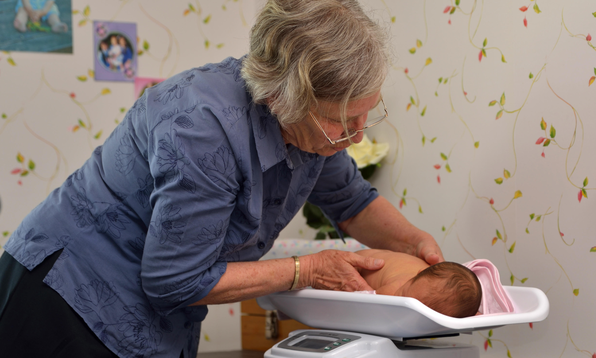
Your baby’s weight and length will be checked at regular health checks. These measurements are compared with standard growth charts to make sure your baby is growing steadily.

Babies often have a growth spurt (when they grow quickly over a short time) at about 6 weeks. This might make them fussier because they want to eat more than usual. 

Understanding baby growth charts

A growth chart helps you and your doctor keep track of how your baby is growing.

Read more

What can my baby do at 2 months old?

Physical Development

At 2 months old, your baby starts to move their body more and gain strength. 

During tummy time, your baby may lift their head for short moments and turn it from side to side. Tummy time is when you place your baby on their tummy while they are awake and you are watching them. It helps your baby build strength in their neck and upper body. 

When lying on their back, your baby may wave their arms and legs and start to reach for dangling objects. Their hands are more relaxed and open. They may grasp an object placed in their hand, but may not yet be able to let go. 

Safety is very important — even though your baby can’t roll, they may kick and wriggle. Never leave your baby alone on a change table or any raised surface.

Social Development

At 2 months old, many babies become more social and responsive.

Your baby may:

  • smile back when you smile at them
  • look at your face and make eye contact
  • enjoy interaction and settle more easily when they hear familiar voices
  • copy simple facial expressions
  • begin to show more regular patterns of feeding, sleeping and being awake

Cognitive Development

Your baby may follow you with their eyes and enjoy looking at faces.

Emotional development

Your baby cries to tell you they are hungry, tired or need a nappy change. They may also cry because they need comfort. Holding and cuddling your baby often helps them feel calm and safe.

Language Development

Your baby may make cooing or gurgling sounds when calm and content. 

How can I help my baby develop?

As your baby starts to settle into a daily rhythm, they are often awake more during the day. This gives you more time to interact and bond with them. 

You can support your baby’s development by:

  • playing with them 
  • letting them look at and feel a variety of objects with different colours, shapes and designs 
  • reading, singing and talking to them 
  • spending time face to face, smiling and responding to their sounds

A baby massage may help your baby relax. After a bath can be a good time.

Help your baby build neck strength by placing them on their tummy for short periods during the day. Aim for a few minutes each time, adding up to at least 30 minutes across the day.

Always stay with your baby during tummy time and always place your baby on their back for sleep.

When should I see my doctor or maternal child health nurse?

Talk to your doctor or maternal child health nurse if your baby:

  • isn’t feeding well
  • cries a lot or is hard to settle
  • isn’t moving their arms or legs
  • isn’t smiling or responding to you when you play with them
  • doesn’t react to loud sounds
  • has sleeping patterns that worry you

At any age, it’s important to speak to your doctor if your baby has stopped doing something they had already learned to do. This is sometimes called ‘regression’.

Read more about common worries and fears for parents.

Resources and support

If you are worried or would like to discuss any issues with your baby’s development, speak to your doctor or maternal child health nurse.

You can also try these support groups:

  • Australian Children’s Education and Care Quality Authority (Opens in new tab) has information about your child’s development from birth to 4 months old.
  • Australian Breastfeeding Association (Opens in new tab) has information about weight gain and growth patterns in breastfed babies.
  • Children’s Health — Queensland Hospital and Health Service (Opens in new tab) has a fact sheet on development skills and activities from birth to 4 months old.
  • Tresillian (Opens in new tab) has information on baby milestones and development.
  • Child Health Info (Opens in new tab) has a child development guide from birth up to 12 months old.

Subscribe (Opens in new tab) to Pregnancy, Birth and Baby’s monthly newsletter for more information about your baby.

Languages other than English

Find information in a range of community languages (Opens in new tab) about your 2-month-old baby’s development.

The Government of Western Australia Child and Adolescent Health Service has translated child health fact sheets (Opens in new tab) in languages other than English.

Information for Aboriginal and/or Torres Strait Islander peoples

Get Up and Grow (Opens in new tab) is a resource for Aboriginal and/or Torres Strait Islander peoples about the first foods you will feed your baby.

Australian Breastfeeding Association (Opens in new tab) has breastfeeding resources for Aboriginal and/or Torres Strait Islander peoples.

SMS4 Deadly Dads (Opens in new tab) helps First Nations dads connect with their bub, support mum and look after themselves.

Speak to a maternal child health nurse

Call Pregnancy, Birth and Baby to speak to a maternal child health nurse on 1800 882 436 (Opens in new tab) or video call. Available 7am to midnight (AET), 7 days a week.

  • European Journal of Clinical Nutrition — Infant growth and body composition from birth to 24 months: are infants developing the same? (Opens in new tab)
  • Queensland Health — Guideline Assessing infant/child nutrition, growth and development within the primary health care setting (Opens in new tab)
  • Nutrients — Infant Growth Spurts in the Context of Perceived Insufficient Milk Supply (Opens in new tab)
  • Australian Government — Developmental milestones and the Early Years Learning Framework and the National Quality Standards (Opens in new tab)
  • Children — First-Time Parents’ Bonding with Their Baby: A Longitudinal Study on Finnish Parents during the First Eight Months of Parenthood (Opens in new tab)
  • Australian Government Department of Health, Disability and Ageing — Childhood immunisation schedule (Opens in new tab)
  • Paediatrics Child Health — Evidence-based milestone ages as a framework for developmental surveillance (Opens in new tab)
  • The Royal Children’s Hospital Melbourne — Clinical Practice Guidelines –Unsettled or crying babies (Opens in new tab)
  • European Journal of Pediatrics — Characteristics of tummy time and dose-response relationships with development in infants (Opens in new tab)
  • The Children’s Hospital at Westmead — Enjoying your baby’s development in the first 12 months of life (Opens in new tab)
  • Government of Western Australia Child and Adolescent Health Service — Your new baby 0-4 months (Opens in new tab)
  • NSW Government — My personal health record (Opens in new tab)
  • Australian Family Physician — Is my child normal? Milestones and red flags for referral (Opens in new tab)
  • Journal of Experimental Child Psychology — Object play and problem solving in infancy: Insights into tool use (Opens in new tab)
  • Queensland Health — Newborn baby assessment (routine) (Opens in new tab)

Find out how we develop and review our content.


Last reviewed: December 2025

Need more information?

These trusted information partners have more on this topic.

Baby development at 1 month | Raising Children Network

Baby development at 1 month is about cuddling, sleeping, feeding and learning. Get tips for baby development and read how to spot developmental delay. Article available in Arabic, Dari, Dinka, Hakha Chin, Karen, Persian, Simplified Chinese, Swahili, Tamil, Vietnamese.
 logo
Learn more on website

Baby development at 1-2 months | Raising Children Network

Extra crying is typical in baby development at 1-2 months, as is more alertness. Get tips to help development and read how to spot developmental delay. Article available in Arabic, Dari, Dinka, Hakha Chin, Karen, Persian, Simplified Chinese, Swahili, Tamil, Vietnamese.
 logo
Learn more on website

First 1000 days of life: development | Raising Children Network

The first 1000 days of life are critical for development. Find out all about baby and child development and how to support it from conception to two years.
 logo
Learn more on website

Kids Health Info : Tummy time for your baby

Royal Children's Hospital logo
Learn more on Royal Children's Hospital website

Tummy Time: What Is It And Why Is It Good For Bub?

Tummy time is important for all bubs from birth. It’s an important way to build strength in shoulder, arm and back muscles and prevent bub from developing a flat spot on the head.
Red Nose logo
Learn more on Red Nose website

First 1000 days: conception to two years | Raising Children Network

The first 1000 days of life are key to lifelong health and wellbeing.
 logo
Learn more on website

Baby Development Guide | Karitane Milestones & Growth

Karitane helps parents understand baby development. Track key milestones and discover ways to support your baby's learning and wellbeing.
Karitane logo
Learn more on Karitane website

Baby Speech Development | Language Development | Tresillian

Babies have an amazing capacity to learn and develop languages. Learn about baby speech development and language milestones.
Tresillian logo
Learn more on Tresillian website

Premature babies and corrected age | Raising Children Network

Corrected age is your premature baby’s chronological age minus how many weeks or months early they were. It helps with tracking premature baby development.
 logo
Learn more on website

Baby Childcare Guide | Karitane Tips for Parents

Karitane offers expert advice on baby childcare. Learn how to choose the right care, ease transitions, and support your baby’s development and wellbeing.
Karitane logo
Learn more on Karitane website

Related pages

  • Your baby's growth and development - 9 months old
  • How your baby's brain develops
  • Routine health checks for babies and children
  • The first 1,000 days
  • Tummy time

Search our site for

  • Infant Nutrition
  • Baby Care

Find a health service

Search now

Need further advice or guidance from our maternal child health nurses?
1800 882 436 Video call
Logo for Pregnancy, Birth and Baby

Pregnancy, Birth and Baby is funded by the Australian Government and operated by Healthdirect Australia.

About

About Pregnancy, Birth and BabyAbout our contentInformation partnersOur privacy commitmentTerms of useHow we use AIPromotional material

Explore

A to Z topicsDue date calculatorFind local health servicesGlossary of pregnancy and labourPregnancy and parenting in picturesPregnancy and baby appsSymptom Checker (Opens in new tab)

Connect

Contact usVideo callNewslettersLinking to us (Opens in new tab)Consumer engagement (Opens in new tab)

Follow

Australian Government, Department of Health, Disability and AgeingLogo for healthdirect Australia

Pregnancy, Birth and Baby’s information and advice are developed and managed within a rigorous clinical governance framework (Opens in new tab).

This site is protected by reCAPTCHA and the Google Privay Policy (Opens in new tab) and Terms of Service (Opens in new tab) apply.

Healthdirect Australia acknowledges the Traditional Owners of Country throughout Australia and their continuing connection to land, sea and community. We pay our respects to the Traditional Owners and to Elders both past and present.

© 2026 Healthdirect Australia Limited

This information is for your general information and use only and is not intended to be used as medical advice and should not be used to diagnose, treat, cure or prevent any medical condition, nor should it be used for therapeutic purposes.
The information is not a substitute for independent professional advice and should not be used as an alternative to professional health care. If you have a particular medical problem, please consult a healthcare professional.
Except as permitted under the Copyright Act 1968, this publication or any part of it may not be reproduced, altered, adapted, stored and/or distributed in any form or by any means without the prior written permission of Healthdirect Australia.