Skip to content
Pregnancy, Birth and Baby homeAustralian Government, Department of Health, Disability and Ageing (Opens in new tab)
Pregnancy, Birth and Baby home
Need to talk? Call 1800 882 436.
It's a free call with a maternal child health nurse. *call charges may apply from your mobile.
Is it an emergency? Dial 000
If you need urgent medical help, call triple zero immediately.
  1. Home/
  2. Babies/
  3. Looking after your newborn/
  4. How to cut your baby's nails

How to cut your baby's nails

Key facts

  • You might not need to cut your baby's nails for the first few months, but when you do, gently trim them with small baby clippers or a gentle file.
  • Your baby may scratch themselves if their nails are too long or sharp.
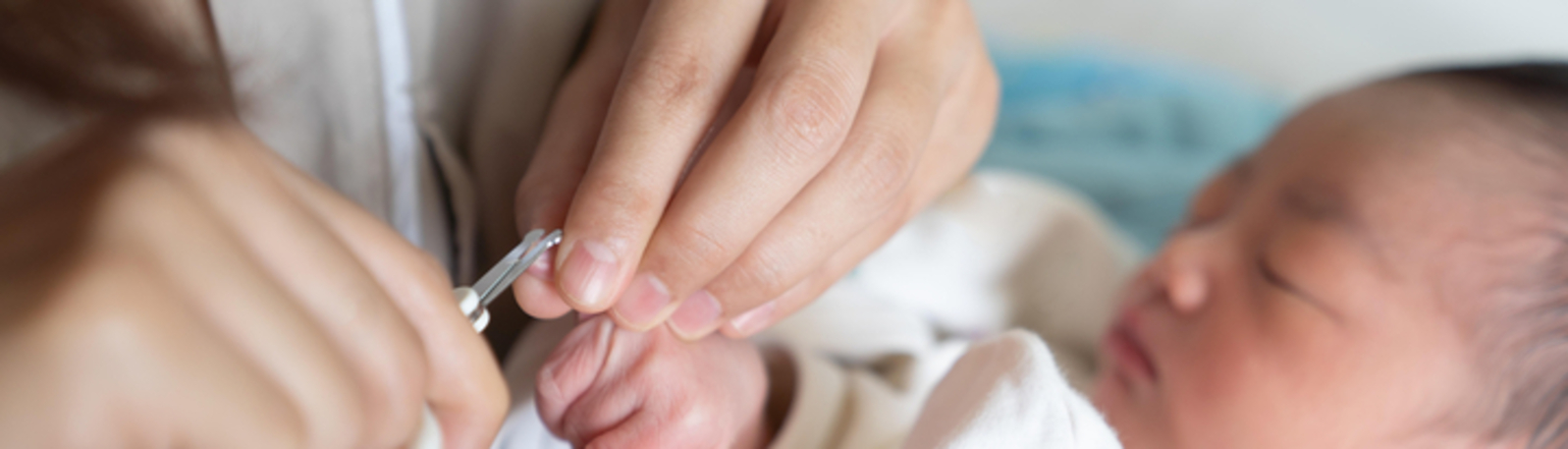
  • Hold your baby's hand or foot firmly and gently pull the pad of their finger or toe away from the nail.
  • Cut the nail straight across using baby nail clippers or scissors.
  • Avoid biting or peeling your baby's nails.
  • On this page

    • Do I need to cut my baby's nails?
    • What can happen if I do not cut my baby's nails?
    • How do I cut my baby's nails?
    • What do healthy nails look like?
    • How do I keep my baby's nails clean and safe?
    • What should I do if something goes wrong?
    • When should I see my doctor?
    • Resources and support

    Do I need to cut my baby's nails?

    You may not need to cut your baby's nails in the first few months. If needed, you can gently trim with small baby clippers or a file.

    Cutting your baby's nails can be tricky because babies move around a lot, but it is important to keep their nails clean and trimmed to help avoid illness and infections.

    What can happen if I do not cut my baby's nails?

    If your baby's nails are too long, they can lead to problems such as:

    • scratches on their face or body (because young babies can't control their arm or leg movements)
    • infection from dirt or germs under the nails
    • pinworms (Opens in new tab), which can spread when your baby touches their bottom and then their mouth
    • ingrown toenails (Opens in new tab), which can be painful and swollen
    • torn nails or cuticles, which can hurt and become infected

    Keeping your baby's nails short and clean helps protect them from these problems.

    How do I cut my baby's nails?

    To cut your baby's nails, you will need to hold their hand or foot firmly so they do not move. It can help if someone else gently holds your baby while you cut.

    You can use baby nail clippers or baby nail scissors with rounded tips. Do not use adult nail clippers. Sometimes you can use an emery board (nail file) to smooth or shape the nail. Your local pharmacy may have ones made especially for babies.

    Your baby may not like having their nails cut. Try talking or singing to them, distracting them with a toy or making a game of it. Praise your baby when you have finished.

    The best time to cut your baby's nails is when they are asleep, or drowsy and calm. After a bath is a good time, because their nails are softer.

    Step-by-step guide

    Follow these steps to safely cut your baby's nails:

    1. Hold your baby in a calm, well-lit space. Try cutting their nails while they are asleep or relaxed.
    2. Clean your baby's nails by using a soft nailbrush or a damp washcloth to gently clean under their nails and remove dirt.
    3. Choose the right tool by using baby-safe clippers or a small nail file. For newborns, a nail file or emery board may be enough.
    4. Firmly hold your baby's hand or foot, then hold each finger or toe in turn as you cut each nail.
    5. Distract your baby if needed by using a toy, singing a song or letting your baby hold a safe object.

    What do healthy nails look like?

    Baby nails are soft and grow quickly. Healthy nails should be:

    • smooth
    • slightly curved
    • free from bumps or dents

    The skin under the nail (called the nail bed) should look pink, which shows good blood flow. The nails themselves may look clear or slightly white at the tips.

    Check your baby's nails regularly for any changes, and speak to your doctor if you notice anything unusual.

    How do I keep my baby's nails clean and safe?

    It is not a good idea to bite your baby's nails with your teeth, because this can spread germs from your mouth and cause an infection.

    Fingernails should be cut straight across and slightly rounded at the edges. Toenails should be cut straight across to prevent ingrown nails (Opens in new tab).

    Your baby might have an infection if the skin next to their nail is:

    • red
    • swollen
    • painful

    If this happens, you can soak their finger or toe in warm water a few times a day and apply some antiseptic cream (Opens in new tab) to keep the area clean. Put a mitten on your baby's hand so they do not suck off the cream.

    If it does not get better, take your baby to their doctor. They may need antibiotics (Opens in new tab).

    What should I do if something goes wrong?

    Even with the best care, it is possible to accidentally cut your baby's finger or toe. If it is bleeding, gently press a soft, clean cloth or cotton pad over the cut until it stops bleeding. Do not put on a dressing or plaster, as your baby might suck or swallow it.

    When should I see my doctor?

    Speak to your doctor if you notice your baby's nails start to look unusual. See your doctor if your baby's nails:

    • look yellow, green or very pale
    • start lifting off the skin

    Look out for infection (if the skin looks red, swollen, or has pus). Take your baby to the doctor if you are worried that the skin may be infected, or if you're not sure. They may need antibiotics (Opens in new tab).

    Resources and support

    The Sydney Children's Hospital has a factsheet on Hand Hygiene for Babies and Children (Opens in new tab).

    Pregnancy, Birth and Baby has an article on children's feet.

    Pregnancy, Birth and Baby has an article on preparing your home for when your baby arrives.

    Speak to a maternal child health nurse

    Call Pregnancy, Birth and Baby to speak to a maternal child health nurse on 1800 882 436 (Opens in new tab) or video call. Available 7am to midnight (AET), 7 days a week.

    • Healthy WA — Child development 0-3 months (Opens in new tab)
    • The Sydney Children's Hospital Network — Hand hygiene for babies and children (Opens in new tab)
    • DermNet NZ — Paronychia (Opens in new tab)
    • The Royal Children's Hospital Melbourne — Skincare for babies (Opens in new tab)
    • Caring for your baby and young child: birth to age 5 — Skin and Nail Care (Opens in new tab)
    • Therapeutic Guidelines — Nail anatomy and types of nail disorders (Opens in new tab)

    Find out how we develop and review our content.


    Last reviewed: July 2025

    Need more information?

    These trusted information partners have more on this topic.

    What we're doing about baby care | Australian Government Department of Health, Disability and Ageing

    A baby’s early care can affect wellbeing throughout life. Find out what we’re doing to ensure health testing, vaccination and care for newborns, and support for new parents.
    Department of Health, Disability and Ageing logo
    Learn more on Department of Health, Disability and Ageing website

    Baby care - moving from cot to bed | Better Health Channel

    betterhealth.vic.gov.au
    Better Health Channel logo
    Learn more on Better Health Channel website

    Kangaroo Care - Miracle Babies

    Miracle Babies Foundation logo
    Learn more on Miracle Babies Foundation website

    WWWT Worksheets/Strategies: Settling your baby

    Sleep and settling strategies for a baby need to be simple and easy to follow, whether you are at home or out. Remember that when overtired or overstimulated your baby may find it more difficult to go to sleep. Soothe your baby, Make the baby comfortable, Soothe your baby, Put your baby into bed, Reassure your baby, Re-settle your baby if necessary.
    What Were We Thinking! logo
    Learn more on What Were We Thinking! website

    Baby bath time: steps to bathing a baby | Raising Children Network

    A bath 2-3 times a week is enough to keep your baby clean. But daily baths are OK if your baby enjoys them. Find out more about baby bath time.
     logo
    Learn more on website

    Settling a crying baby factsheet

    Crying is a normal part of your baby’s communication and development. There are strategies to help settle your baby and look after yourself.
    Sydney Children's Hospitals Network logo
    Learn more on Sydney Children's Hospitals Network website

    Baby massage guide in pictures | Raising Children Network

    Baby massage can soothe your baby and help with bonding. Use smooth, gentle strokes, and stop if your baby gets upset. See more steps for baby massage.
     logo
    Learn more on website

    Baby bath aids guide | ACCC Product Safety

    Baby bath aids are not safety devices. Make sure you buy a baby bath aid with a safety warning statement on the product. Always supervise your baby in the bath.
    ACCC Product Safety logo
    Learn more on ACCC Product Safety website

    Getting your baby to sleep | NSW Government

    Establishing a sleep routine for your baby is important. Information on safe sleeping practices, settling and where to get help if your baby isn't sleeping.
    NSW Health logo
    Learn more on NSW Health website

    How to wrap a baby | Raising Children Network

    See how to wrap a baby in this video. Wrapping can reduce SUDI and SIDS risk by keeping babies on their backs during sleep. It can also soothe babies.
     logo
    Learn more on website

    Related pages

    • Baby massage
    • Cleaning your baby's ears, eyes and nose
    • Getting your baby to sleep
    • Looking after your baby's skin
    • Responsive settling

    Search our site for

    • Newborn Infants
    • Nappy Rash
    • Crying
    • Cradle Cap
    • Neonatal and infantile acne
    • Baby development

    Find a health service

    Search now

    Need further advice or guidance from our maternal child health nurses?
    1800 882 436 Video call
    Logo for Pregnancy, Birth and Baby

    Pregnancy, Birth and Baby is funded by the Australian Government and operated by Healthdirect Australia.

    About

    About Pregnancy, Birth and BabyAbout our contentInformation partnersOur privacy commitmentTerms of useHow we use AIPromotional material

    Explore

    A to Z topicsDue date calculatorFind local health servicesGlossary of pregnancy and labourPregnancy and parenting in picturesPregnancy and baby appsSymptom Checker (Opens in new tab)

    Connect

    Contact usVideo callNewslettersLinking to us (Opens in new tab)Consumer engagement (Opens in new tab)

    Follow

    Australian Government, Department of Health, Disability and AgeingLogo for healthdirect Australia

    Pregnancy, Birth and Baby’s information and advice are developed and managed within a rigorous clinical governance framework (Opens in new tab).

    This site is protected by reCAPTCHA and the Google Privay Policy (Opens in new tab) and Terms of Service (Opens in new tab) apply.

    Healthdirect Australia acknowledges the Traditional Owners of Country throughout Australia and their continuing connection to land, sea and community. We pay our respects to the Traditional Owners and to Elders both past and present.

    © 2026 Healthdirect Australia Limited

    This information is for your general information and use only and is not intended to be used as medical advice and should not be used to diagnose, treat, cure or prevent any medical condition, nor should it be used for therapeutic purposes.
    The information is not a substitute for independent professional advice and should not be used as an alternative to professional health care. If you have a particular medical problem, please consult a healthcare professional.
    Except as permitted under the Copyright Act 1968, this publication or any part of it may not be reproduced, altered, adapted, stored and/or distributed in any form or by any means without the prior written permission of Healthdirect Australia.